Advertisements
Advertisements
प्रश्न
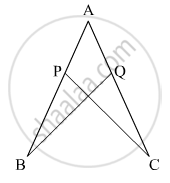
In the given figure, if AB = AC and ∠B = ∠C. Prove that BQ = CP.
Advertisements
उत्तर
It is given that
AB = AC , and ∠B = ∠C
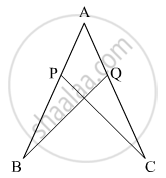
We have to prove that BQ = CP
We basically will prove ΔABQ ≅ ΔACP to show BQ = CP
In ΔABQ and ΔACP
∠B = ∠C (Given)
AB = AC(Given)
And ∠A is common in both the triangles
So all the properties of congruence are satisfied
So ΔABQ ≅ ΔACP
Hence BQ = CP Proved.
APPEARS IN
संबंधित प्रश्न
If ΔDEF ≅ ΔBCA, write the part(s) of ΔBCA that correspond to `bar(DF)`
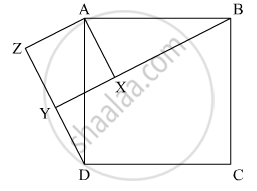
In the given figure, X is a point in the interior of square ABCD. AXYZ is also a square. If DY = 3 cm and AZ = 2 cm, then BY =
In the following diagram, AP and BQ are equal and parallel to each other.
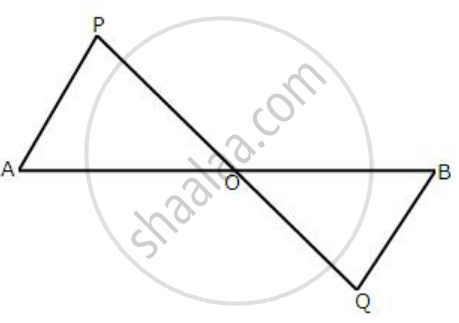
Prove that:
- ΔAOP ≅ ΔBOQ.
- AB and PQ bisect each other.
In the following figure, OA = OC and AB = BC.
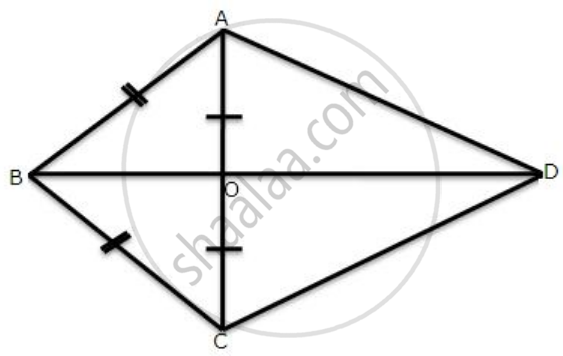
Prove that: AD = CD
In ΔABC, AB = AC. D is a point in the interior of the triangle such that ∠DBC = ∠DCB. Prove that AD bisects ∠BAC of ΔABC.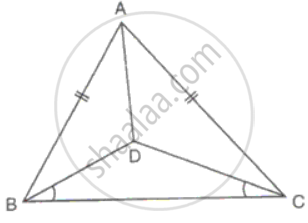
O is any point in the ΔABC such that the perpendicular drawn from O on AB and AC are equal. Prove that OA is the bisector of ∠BAC.
Two right-angled triangles ABC and ADC have the same base AC. If BC = DC, prove that AC bisects ∠BCD.
PQRS is a quadrilateral and T and U are points on PS and RS respectively such that PQ = RQ, ∠PQT = ∠RQU and ∠TQS = ∠UQS. Prove that QT = QU.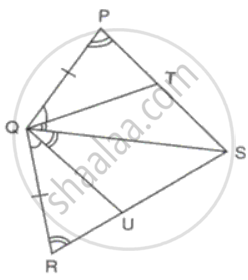
∆ABC and ∆PQR are congruent under the correspondence:
ABC ↔ RQP
Write the parts of ∆ABC that correspond to
(i) `bar"PQ"`
(ii)∠Q
(iii) `bar"RP"`
Is it possible to construct a triangle with lengths of its sides as 4 cm, 3 cm and 7 cm? Give reason for your answer.
