Advertisements
Advertisements
प्रश्न
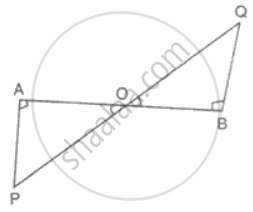
In the figure, AP and BQ are perpendiculars to the line segment AB and AP = BQ. Prove that O is the mid-point of the line segments AB and PQ.
Advertisements
उत्तर
Since AP and BQ are perpendiculars to the line segment AB, therefore Ap and BQ are parallel to each other.
In ΔAOP and ΔBOQ
∠PAQ = ∠QBO = 90°
∠APO = ∠BQO ...(alternate angles)
AP = BQ
Therefore, ΔAOP ≅ ΔBOQ AOP BOQ ...(ASA criteria)
Hence, AO = OB and PO = OQ
Thus, O is the mid-point of the line segments AB and PQ.
APPEARS IN
संबंधित प्रश्न
If ΔDEF ≅ ΔBCA, write the part(s) of ΔBCA that correspond to ∠E
Complete the congruence statement:
ΔBCA ≅?
ΔQRS ≅?

In a ΔPQR, if PQ = QR and L, M and N are the mid-points of the sides PQ, QR and RP
respectively. Prove that: LN = MN.
If ΔABC ≅ ΔABC is isosceles with
If ABC and DEF are two triangles such that ΔABC \[\cong\] ΔFDE and AB = 5cm, ∠B = 40°
In the given figure, X is a point in the interior of square ABCD. AXYZ is also a square. If DY = 3 cm and AZ = 2 cm, then BY =

In the following diagram, AP and BQ are equal and parallel to each other.

Prove that:
- ΔAOP ≅ ΔBOQ.
- AB and PQ bisect each other.
Prove that:
- ∆ ABD ≅ ∆ ACD
- ∠B = ∠C
- ∠ADB = ∠ADC
- ∠ADB = 90°

AD and BE are altitudes of an isosceles triangle ABC with AC = BC. Prove that AE = BD.
Is it possible to construct a triangle with lengths of its sides as 4 cm, 3 cm and 7 cm? Give reason for your answer.
