Advertisements
Advertisements
प्रश्न
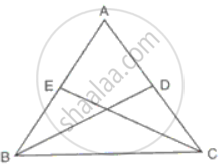
ΔABC is isosceles with AB = AC. BD and CE are two medians of the triangle. Prove that BD = CE.
Advertisements
उत्तर
CE is median to AB
⇒ AE = BE ......(i)
BD is median to AC
⇒ AD = DC ......(i)
But AB =AC ......(iii)
Therefore from (i), (ii) and (iii)
BE = CD
In ΔBEC and ΔBDC
BE = CD
∠EBC = ∠DCB ...(angles opposites to equal sides are equal)
BC = BC ...(common)
Therefore, ΔBEC ≅ ΔBDC ...(SAS criteria)
Hence, BD = CE.
APPEARS IN
संबंधित प्रश्न
If ΔDEF ≅ ΔBCA, write the part(s) of ΔBCA that correspond to ∠E
CDE is an equilateral triangle formed on a side CD of a square ABCD. Show that ΔADE ≅ΔBCE.
In triangles ABC and PQR, if ∠A = ∠R, ∠B = ∠P and AB = RP, then which one of the following congruence conditions applies:
If the following pair of the triangle is congruent? state the condition of congruency:
In ΔABC and ΔPQR, BC = QR, ∠A = 90°, ∠C = ∠R = 40° and ∠Q = 50°.
State, whether the pairs of triangles given in the following figures are congruent or not:

In the figure, AB = EF, BC = DE, AB and FE are perpendiculars on BE. Prove that ΔABD ≅ ΔFEC
In the figure, ∠BCD = ∠ADC and ∠ACB =∠BDA. Prove that AD = BC and ∠A = ∠B.
Which of the following rule is not sufficient to verify the congruency of two triangles
It is given that ∆ABC ≅ ∆RPQ. Is it true to say that BC = QR? Why?
The congruent figures super impose each other completely.
