Advertisements
Advertisements
प्रश्न
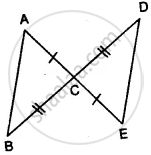
In the given figure, prove that:
(i) ∆ ACB ≅ ∆ ECD
(ii) AB = ED
Advertisements
उत्तर
(i) In Δ ACB and Δ ECD,
AC = CE ................(given)
∠ACB = ∠DCE ............(vertically opposite angles)
BC = CD .............(given)
∴ Δ ACB ≅ Δ ECD ..............(S.A.S. Axiom)
(ii) Hence AB = ED ................(c.p.c.t.)
Hence proved.
APPEARS IN
संबंधित प्रश्न
Find the measure of each angle of an equilateral triangle.
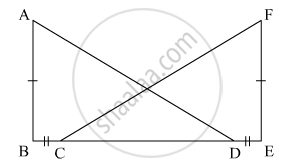
In the given figure, AB ⊥ BE and FE ⊥ BE. If BC = DE and AB = EF, then ΔABD is congruent to
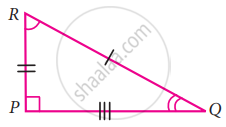
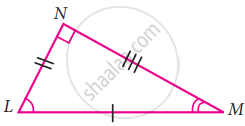
In the pair of triangles in the following figure, parts bearing identical marks are congruent. State the test and the correspondence of vertices by the triangle in pairs is congruent.
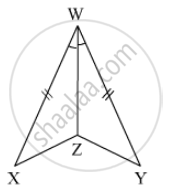
In the pair of triangles in the following figure, parts bearing identical marks are congruent. State the test and the correspondence of vertices by the triangle in pairs is congruent.
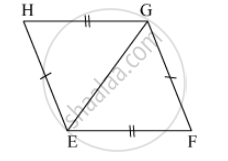
In the pair of triangles in the following figure, parts bearing identical marks are congruent. State the test and the correspondence of vertices by the triangle in pairs is congruent.
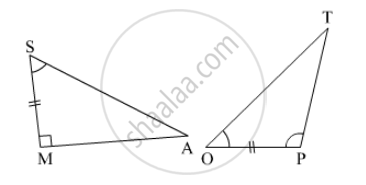
State, whether the pairs of triangles given in the following figures are congruent or not:
Δ ABC in which AB = 2 cm, BC = 3.5 cm and ∠C = 80° and Δ DEF in which DE = 2 cm, DF = 3.5 cm and ∠D = 80°.
In the figure, AB = EF, BC = DE, AB and FE are perpendiculars on BE. Prove that ΔABD ≅ ΔFEC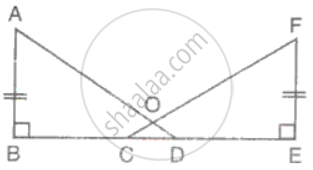
In the figure, AC = AE, AB = AD and ∠BAD = ∠EAC. Prove that BC = DE.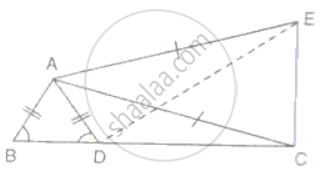
In ΔABC, AB = AC, BM and Cn are perpendiculars on AC and AB respectively. Prove that BM = CN.
If the given two triangles are congruent, then identify all the corresponding sides and also write the congruent angles