Advertisements
Advertisements
प्रश्न
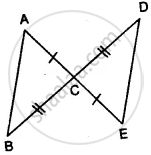
In the given figure, prove that:
(i) ∆ ACB ≅ ∆ ECD
(ii) AB = ED
Advertisements
उत्तर
(i) In Δ ACB and Δ ECD,
AC = CE ................(given)
∠ACB = ∠DCE ............(vertically opposite angles)
BC = CD .............(given)
∴ Δ ACB ≅ Δ ECD ..............(S.A.S. Axiom)
(ii) Hence AB = ED ................(c.p.c.t.)
Hence proved.
APPEARS IN
संबंधित प्रश्न
In a ΔPQR, if PQ = QR and L, M and N are the mid-points of the sides PQ, QR and RP
respectively. Prove that: LN = MN.
In ΔPQR ≅ ΔEFD then ED =
If ΔPQR≅ ΔEFD, then ∠E =
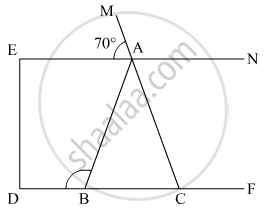
In the given figure, if AE || DC and AB = AC, the value of ∠ABD is
Observe the information shown in pair of triangle given below. State the test by which the two triangles are congruent. Write the remaining congruent parts of the triangles.
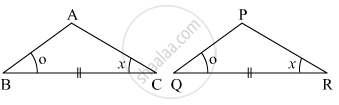
From the information shown in the figure,
In ΔABC and ΔPQR
∠ABC ≅ ∠PQR
seg BC ≅ seg QR
∠ACB ≅ ∠PRQ
∴ ΔABC ≅ ΔPQR ...`square` test
∴ ∠BAC ≅ `square` ...corresponding angles of congruent triangles.
`{:("seg AB" ≅ square),("and" square ≅ "seg PR"):}}` ...corresponding sides of congruent triangles
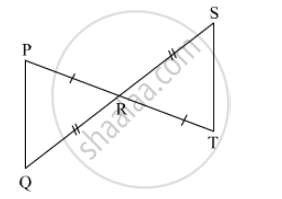
In the pair of triangles given below, the parts shown by identical marks are congruent. State the test and the one-to-one correspondence of vertices by which the triangles in the pair are congruent, the remaining congruent parts.
In the given figure, AB = DB and AC = DC. Find the values of x and y.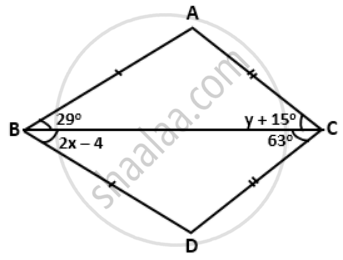
If AB = QR, BC = PR and CA = PQ, then ______.
In triangles ABC and PQR, ∠A = ∠Q and ∠B = ∠R. Which side of ∆PQR should be equal to side AB of ∆ABC so that the two triangles are congruent? Give reason for your answer.
Without drawing the triangles write all six pairs of equal measures in the following pairs of congruent triangles.
∆STU ≅ ∆DEF
