Advertisements
Advertisements
प्रश्न
In the following diagram, AP and BQ are equal and parallel to each other.
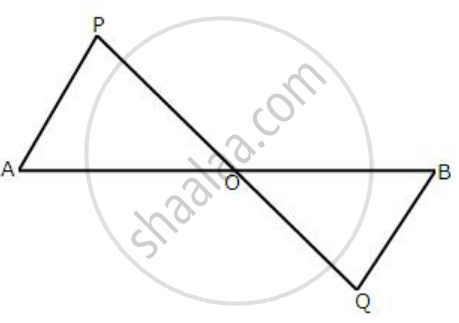
Prove that:
- ΔAOP ≅ ΔBOQ.
- AB and PQ bisect each other.
Advertisements
उत्तर
In the figure, AP and BQ are equal and parallel to each other.
∴ AP = BQ and AP || BQ.
We need to prove that
(i) ΔAOP≅ ΔBOQ.
(ii) AB and PQ bisect each other
(i) ∵ AP || BQ
∴ ∠APO = ∠BOQ ...[Alternate angles]...(1)
and ∠PAO = ∠QBO ...[Alternate angles]...(2)
Now in ΔAOP and ΔBOQ.
∠APO = ∠BQO ...[From (1)]
AP = BQ ...[Given]
∠PAO = ∠QBO ...[From (1)]
∴ By Angel-Side-Angel criterion of congruence, we have
ΔAOP ≅ ΔBOQ
(ii) The corresponding parts of the congruent triangles are congruent.
∴ OP = OQ ...[c. p. c. t]
OA = OB ...[c. p. c. t]
Hence, AB and PQ bisect each other.
APPEARS IN
संबंधित प्रश्न
In a ΔABC, if AB = AC and ∠B = 70°, find ∠A.
Find the measure of each angle of an equilateral triangle.
ΔPQR and ΔABC is not congruent to ΔRPQ, then which of the following is not true:
Which of the following is not a criterion for congruence of triangles?
The following figure has shown a triangle ABC in which AB = AC. M is a point on AB and N is a point on AC such that BM = CN.
Prove that: (i) AM = AN (ii) ΔAMC ≅ ΔANB

Which of the following pairs of triangles are congruent? Give reasons
ΔABC;(∠B = 90°,BC = 6cm,AB = 8cm);
ΔPQR;(∠Q = 90°,PQ = 6cm,PR = 10cm).
In triangles ABC and DEF, AB = FD and ∠A = ∠D. The two triangles will be congruent by SAS axiom if ______.
Is it possible to construct a triangle with lengths of its sides as 4 cm, 3 cm and 7 cm? Give reason for your answer.
Without drawing the triangles write all six pairs of equal measures in the following pairs of congruent triangles.
∆ABC ≅ ∆LMN
Without drawing the triangles write all six pairs of equal measures in the following pairs of congruent triangles.
∆YZX ≅ ∆PQR
