Advertisements
Advertisements
प्रश्न
Find the measure of each angle of an equilateral triangle.
Advertisements
उत्तर
In equilateral triangle we know that each angle is equal
So ∠A = ∠B = ∠C
Now ∠A + ∠B + ∠C = 180° (by triangle property)
3∠A = 180°
∠A = 60°
Hence. ∠A = ∠B = ∠C = 60°
APPEARS IN
संबंधित प्रश्न
Complete the congruence statement:
ΔBCA ≅?
ΔQRS ≅?
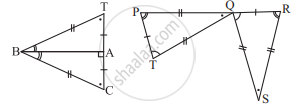
If ΔABC ≅ ΔABC is isosceles with
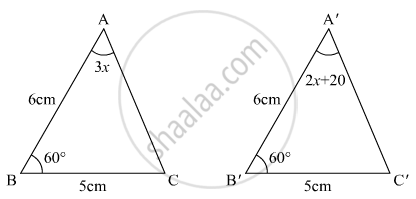
In the given figure, the measure of ∠B'A'C' is
In the figure, BC = CE and ∠1 = ∠2. Prove that ΔGCB ≅ ΔDCE.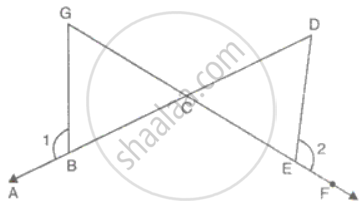
In the figure, BM and DN are both perpendiculars on AC and BM = DN. Prove that AC bisects BD.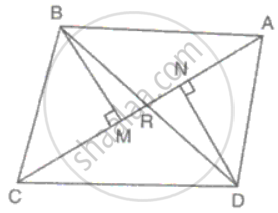
In ΔPQR, LM = MN, QM = MR and ML and MN are perpendiculars on PQ and PR respectively. Prove that PQ = PR.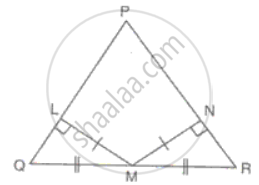
AD and BE are altitudes of an isosceles triangle ABC with AC = BC. Prove that AE = BD.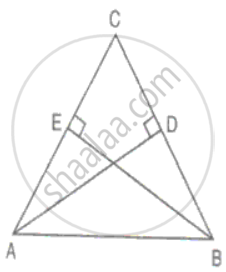
In the figure, AP and BQ are perpendiculars to the line segment AB and AP = BQ. Prove that O is the mid-point of the line segments AB and PQ.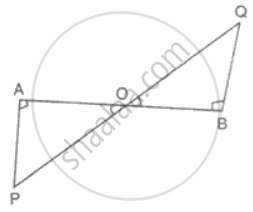
Which of the following rule is not sufficient to verify the congruency of two triangles
The top and bottom faces of a kaleidoscope are congruent.
