Advertisements
Advertisements
प्रश्न
ABC is an isosceles triangle in which AB = AC. BE and CF are its two medians. Show that BE = CF.
Advertisements
उत्तर
In the triangle ABC it is given that
AB = AC, BE and CFare medians.
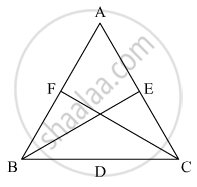
We have to show that BE CF
To show BF = CF we will show that ΔBFC ≅ ΔBEC
In triangle ΔBFC and ΔBEC
As AB = AC, so
∠FBC = ∠ECF .........(1)
BC=BC (common sides) ........(2)
Since,
AB = AC
`1/2 AB =1/2 AC `
As F and E are mid points of sides AB and AC respectively, so
BF = CE ..........(3)
From equation (1), (2), and (3)
ΔBFC and ΔBEC
Hence FC = BE Proved.
APPEARS IN
संबंधित प्रश्न
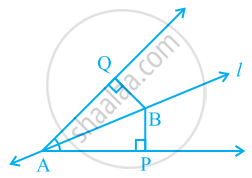
Line l is the bisector of an angle ∠A and B is any point on l. BP and BQ are perpendiculars from B to the arms of ∠A (see the given figure). Show that:
- ΔAPB ≅ ΔAQB
- BP = BQ or B is equidistant from the arms of ∠A.
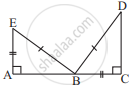
Which congruence criterion do you use in the following?
Given: EB = DB
AE = BC
∠A = ∠C = 90°
So, ΔABE ≅ ΔCDB
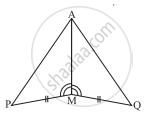
You have to show that ΔAMP ≅ AMQ.
In the following proof, supply the missing reasons.
| Steps | Reasons | ||
| 1 | PM = QM | 1 | ... |
| 2 | ∠PMA = ∠QMA | 2 | ... |
| 3 | AM = AM | 3 | ... |
| 4 | ΔAMP ≅ ΔAMQ | 4 | ... |
In two triangles ABC and ADC, if AB = AD and BC = CD. Are they congruent?
D, E, F are the mid-point of the sides BC, CA and AB respectively of ΔABC. Then ΔDEF is congruent to triangle
The given figure shows a circle with center O. P is mid-point of chord AB.
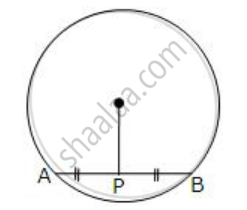
Show that OP is perpendicular to AB.
A line segment AB is bisected at point P and through point P another line segment PQ, which is perpendicular to AB, is drawn. Show that: QA = QB.
ABCD is a parallelogram. The sides AB and AD are produced to E and F respectively, such produced to E and F respectively, such that AB = BE and AD = DF.
Prove that: ΔBEC ≅ ΔDCF.
In the following figure, ABC is an equilateral triangle in which QP is parallel to AC. Side AC is produced up to point R so that CR = BP.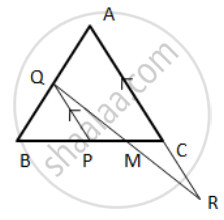
Prove that QR bisects PC.
Hint: ( Show that ∆ QBP is equilateral
⇒ BP = PQ, but BP = CR
⇒ PQ = CR ⇒ ∆ QPM ≅ ∆ RCM ).
ABC is an isosceles triangle with AB = AC and BD and CE are its two medians. Show that BD = CE.
