Advertisements
Advertisements
प्रश्न
Prove that the perimeter of a triangle is greater than the sum of its altitudes.
Advertisements
उत्तर
We have to prove that the perimeter of a triangle is greater than the sum of its altitude.
In ΔABC
AD⊥ BC , BE ⊥ AC , CF⊥AB
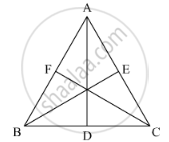
We have to prove
AB + BC + CD > AD + BE + CF
Since AD⊥ BC
So AB > AD and AC > AD
By adding AB + AC > AD + AD, we have
AB + AC > 2AD ........(1)
Now consider BE ⊥ AC then
BC > BE, and BA > BE
Now by adding BC + BA > 2BE .......(2)
Again consider CF⊥AB
AC > CF, and BC > CF
By adding AC + BC > 2CF ...........(3)
Adding (1), (2) and (3), we get
2(AB + BC + CA)>2 (AD + BE + CF)
⇒ AB + BC + CA > AD + BE + CF
Hence the perimeter of a triangle is greater than the sum of all its altitude.
APPEARS IN
संबंधित प्रश्न
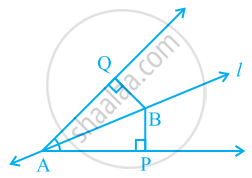
Line l is the bisector of an angle ∠A and B is any point on l. BP and BQ are perpendiculars from B to the arms of ∠A (see the given figure). Show that:
- ΔAPB ≅ ΔAQB
- BP = BQ or B is equidistant from the arms of ∠A.
In right triangle ABC, right angled at C, M is the mid-point of hypotenuse AB. C is joined to M and produced to a point D such that DM = CM. Point D is joined to point B (see the given figure). Show that:
- ΔAMC ≅ ΔBMD
- ∠DBC is a right angle.
- ΔDBC ≅ ΔACB
- CM = `1/2` AB

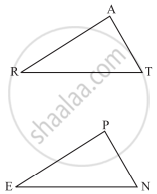
You want to show that ΔART ≅ ΔPEN,
If it is given that ∠T = ∠N and you are to use SAS criterion, you need to have
1) RT = and
2) PN =
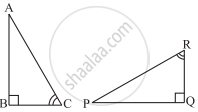
In ΔABC, ∠A = 30°, ∠B = 40° and ∠C = 110°
In ΔPQR, ∠P = 30°, ∠Q = 40° and ∠R = 110°
A student says that ΔABC ≅ ΔPQR by AAA congruence criterion. Is he justified? Why or why not?
If ΔABC and ΔPQR are to be congruent, name one additional pair of corresponding parts. What criterion did you use?
If perpendiculars from any point within an angle on its arms are congruent, prove that it lies on the bisector of that angle.
A triangle ABC has ∠B = ∠C.
Prove that: The perpendiculars from the mid-point of BC to AB and AC are equal.
The perpendicular bisectors of the sides of a triangle ABC meet at I.
Prove that: IA = IB = IC.
From the given diagram, in which ABCD is a parallelogram, ABL is a line segment and E is mid-point of BC.
Prove that: AB = BL.
In the following figure, BL = CM.
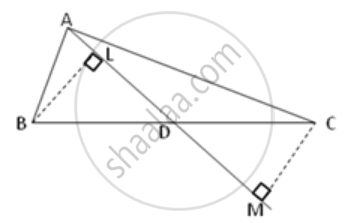
Prove that AD is a median of triangle ABC.
