Advertisements
Advertisements
Question
Prove that the perimeter of a triangle is greater than the sum of its altitudes.
Advertisements
Solution
We have to prove that the perimeter of a triangle is greater than the sum of its altitude.
In ΔABC
AD⊥ BC , BE ⊥ AC , CF⊥AB
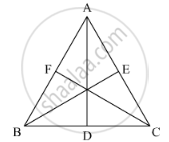
We have to prove
AB + BC + CD > AD + BE + CF
Since AD⊥ BC
So AB > AD and AC > AD
By adding AB + AC > AD + AD, we have
AB + AC > 2AD ........(1)
Now consider BE ⊥ AC then
BC > BE, and BA > BE
Now by adding BC + BA > 2BE .......(2)
Again consider CF⊥AB
AC > CF, and BC > CF
By adding AC + BC > 2CF ...........(3)
Adding (1), (2) and (3), we get
2(AB + BC + CA)>2 (AD + BE + CF)
⇒ AB + BC + CA > AD + BE + CF
Hence the perimeter of a triangle is greater than the sum of all its altitude.
APPEARS IN
RELATED QUESTIONS
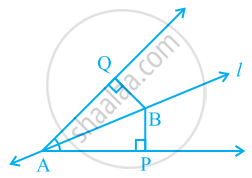
Line l is the bisector of an angle ∠A and B is any point on l. BP and BQ are perpendiculars from B to the arms of ∠A (see the given figure). Show that:
- ΔAPB ≅ ΔAQB
- BP = BQ or B is equidistant from the arms of ∠A.
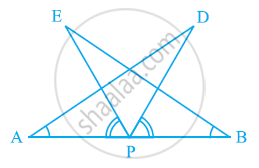
AB is a line segment and P is its mid-point. D and E are points on the same side of AB such that ∠BAD = ∠ABE and ∠EPA = ∠DPB (See the given figure). Show that
- ΔDAP ≅ ΔEBP
- AD = BE
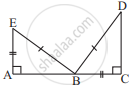
Which congruence criterion do you use in the following?
Given: EB = DB
AE = BC
∠A = ∠C = 90°
So, ΔABE ≅ ΔCDB
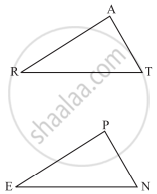
You want to show that ΔART ≅ ΔPEN,
If it is given that AT = PN and you are to use ASA criterion, you need to have
1) ?
2) ?
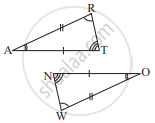
In the figure, the two triangles are congruent.
The corresponding parts are marked. We can write ΔRAT ≅ ?
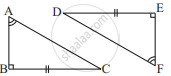
Explain, why ΔABC ≅ ΔFED.
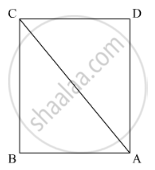
In the given figure, prove that:
CD + DA + AB > BC
ABC is an isosceles triangle in which AB = AC. BE and CF are its two medians. Show that BE = CF.
From the given diagram, in which ABCD is a parallelogram, ABL is a line segment and E is mid-point of BC.
Prove that: AB = BL.
In a ΔABC, BD is the median to the side AC, BD is produced to E such that BD = DE.
Prove that: AE is parallel to BC.
