Advertisements
Advertisements
Question
In the following figure, AB = EF, BC = DE and ∠B = ∠E = 90°.
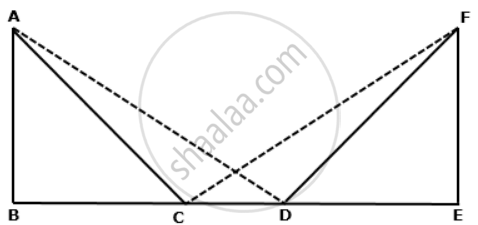
Prove that AD = FC.
Advertisements
Solution
Given that, BC = DE
⇒ BC + CD = DE + CD ....( Adding CD on both sides )
⇒ BD = CE ....(i)
Now, in ΔABD and ΔFEC,
AB = EF ....(given)
∠ABD = ∠FEC ....(Each 90°)
BD = CE ....[ From (i) ]
⇒ ΔABD ≅ ΔFEC ...(by SAS congruence criterion)
⇒ AD = FC ...(c.p.c.t.)
APPEARS IN
RELATED QUESTIONS
Which congruence criterion do you use in the following?
Given: AC = DF
AB = DE
BC = EF
So, ΔABC ≅ ΔDEF

Which congruence criterion do you use in the following?
Given: EB = DB
AE = BC
∠A = ∠C = 90°
So, ΔABE ≅ ΔCDB

You want to show that ΔART ≅ ΔPEN,
If you have to use SSS criterion, then you need to show
1) AR =
2) RT =
3) AT =

Explain, why ΔABC ≅ ΔFED.

If ABC and DEF are two triangles such that AC = 2.5 cm, BC = 5 cm, ∠C = 75°, DE = 2.5 cm, DF = 5cm and ∠D = 75°. Are two triangles congruent?
In the given figure, ABC is an isosceles triangle whose side AC is produced to E. Through C, CD is drawn parallel to BA. The value of x is

If AP bisects angle BAC and M is any point on AP, prove that the perpendiculars drawn from M to AB and AC are equal.
In ∆ABC, AB = AC. Show that the altitude AD is median also.
In the following figure, AB = AC and AD is perpendicular to BC. BE bisects angle B and EF is perpendicular to AB.
Prove that : ED = EF

In quadrilateral ABCD, AD = BC and BD = CA.
Prove that:
(i) ∠ADB = ∠BCA
(ii) ∠DAB = ∠CBA