Advertisements
Advertisements
Question
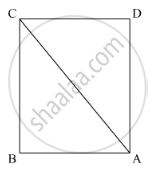
In the given figure, prove that:
CD + DA + AB + BC > 2AC
Advertisements
Solution
We have to prove that CD + DA + AB + BC > 2AC
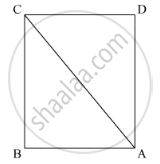
In ΔABC we have
AB + BC > AC (As sum of two sides of triangle is greater than third one) ........(1)
In ΔACDwe have
AD + CD > AC (As sum of two sides of triangle is greater than third one) .........(2)
Hence
Adding (1) & (2) we get AB + BC + AC + CD > 2AC Proved.
APPEARS IN
RELATED QUESTIONS
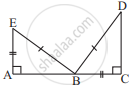
Which congruence criterion do you use in the following?
Given: EB = DB
AE = BC
∠A = ∠C = 90°
So, ΔABE ≅ ΔCDB
In ΔABC, ∠A = 30°, ∠B = 40° and ∠C = 110°
In ΔPQR, ∠P = 30°, ∠Q = 40° and ∠R = 110°
A student says that ΔABC ≅ ΔPQR by AAA congruence criterion. Is he justified? Why or why not?
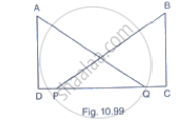
In Fig. 10.99, AD ⊥ CD and CB ⊥. CD. If AQ = BP and DP = CQ, prove that ∠DAQ = ∠CBP.
Prove that the perimeter of a triangle is greater than the sum of its altitudes.
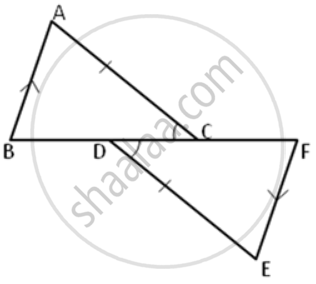
In two congruent triangles ABC and DEF, if AB = DE and BC = EF. Name the pairs of equal angles.
Use the information in the given figure to prove:
- AB = FE
- BD = CF
The following figure shows a circle with center O.
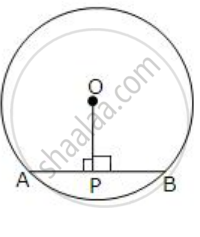
If OP is perpendicular to AB, prove that AP = BP.
If AP bisects angle BAC and M is any point on AP, prove that the perpendiculars drawn from M to AB and AC are equal.
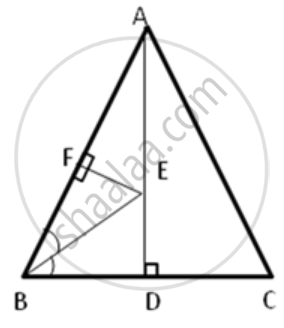
In the following figure, AB = AC and AD is perpendicular to BC. BE bisects angle B and EF is perpendicular to AB.
Prove that: BD = CD
In the following figure, ∠A = ∠C and AB = BC.
Prove that ΔABD ≅ ΔCBE.