Advertisements
Advertisements
Question
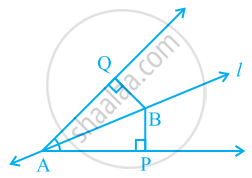
Line l is the bisector of an angle ∠A and B is any point on l. BP and BQ are perpendiculars from B to the arms of ∠A (see the given figure). Show that:
- ΔAPB ≅ ΔAQB
- BP = BQ or B is equidistant from the arms of ∠A.
Advertisements
Solution
We have, l is the bisector of ∠QAP.
∴ ∠QAB = ∠PAB
and ∠Q = ∠P ...[Each 90°]
⇒ ∠ABQ = ∠ABP ...[By angle sum property of △]
i. Now, in △APB and △AQB, we have
∠ABP = ∠ABQ ...[Proved above]
AB = BA ...[Common]
∠PAB ≅ ∠QAB ...[Given]
△APB ≅ △AQB ...[By ASA congruency]
ii. Since, △APB ≅ △AQB
⇒ BP = BQ ...[By Corresponding parts of congruent triangles]
i.e., [Perpendicular distance of B from AP] = [Perpendicular distance of B from AQ]
Thus, the point B is equidistant from the arms of ∠A.
APPEARS IN
RELATED QUESTIONS
In right triangle ABC, right angled at C, M is the mid-point of hypotenuse AB. C is joined to M and produced to a point D such that DM = CM. Point D is joined to point B (see the given figure). Show that:
- ΔAMC ≅ ΔBMD
- ∠DBC is a right angle.
- ΔDBC ≅ ΔACB
- CM = `1/2` AB

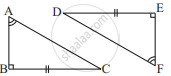
Explain, why ΔABC ≅ ΔFED.
Which of the following statements are true (T) and which are false (F):
If any two sides of a right triangle are respectively equal to two sides of other right triangle, then the two triangles are congruent.
In two triangles ABC and ADC, if AB = AD and BC = CD. Are they congruent?
D, E, F are the mid-point of the sides BC, CA and AB respectively of ΔABC. Then ΔDEF is congruent to triangle
In a triangle ABC, D is mid-point of BC; AD is produced up to E so that DE = AD. Prove that:
AB is parallel to EC.
A triangle ABC has ∠B = ∠C.
Prove that: The perpendiculars from B and C to the opposite sides are equal.
In the following diagram, AP and BQ are equal and parallel to each other. 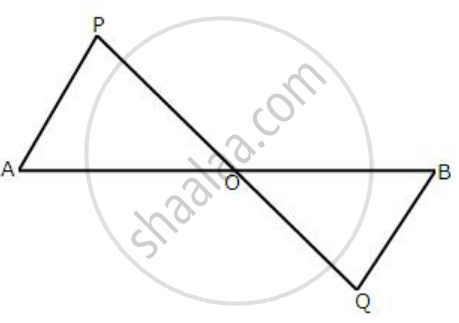
Prove that: AB and PQ bisect each other.
In quadrilateral ABCD, AD = BC and BD = CA.
Prove that:
(i) ∠ADB = ∠BCA
(ii) ∠DAB = ∠CBA
In a triangle, ABC, AB = BC, AD is perpendicular to side BC and CE is perpendicular to side AB.
Prove that: AD = CE.
