Advertisements
Advertisements
Question
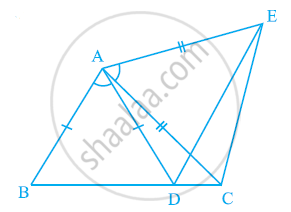
In the given figure, AC = AE, AB = AD and ∠BAD = ∠EAC. Show that BC = DE.
Advertisements
Solution
Given that
∠BAD = ∠EAC
On adding ∠DAC on both sides, we get
∠BAD + ∠DAC = ∠EAC + ∠DAC
⇒ ∠BAC = ∠EAD …(I)
Now, in △ABC and △AED,
AB = AD ...[Given]
AC = AE ...[Given]
∠BAC = ∠EAD ...[By (I)]
∴ △ABC ≌ △ADE ...[By AAS congruence rule]
⇒ BC = DE ...[Corresponding parts of congruent triangles]
APPEARS IN
RELATED QUESTIONS
You want to show that ΔART ≅ ΔPEN,
If you have to use SSS criterion, then you need to show
1) AR =
2) RT =
3) AT =
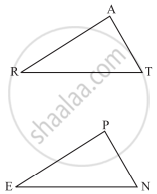
You want to show that ΔART ≅ ΔPEN,
If it is given that ∠T = ∠N and you are to use SAS criterion, you need to have
1) RT = and
2) PN =
In Δ ABC, ∠B = 35°, ∠C = 65° and the bisector of ∠BAC meets BC in P. Arrange AP, BP and CP in descending order.
D, E, F are the mid-point of the sides BC, CA and AB respectively of ΔABC. Then ΔDEF is congruent to triangle
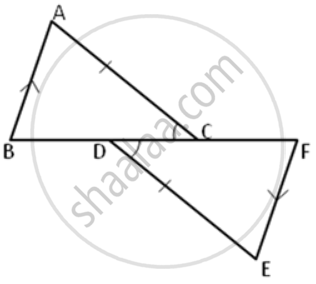
Use the information in the given figure to prove:
- AB = FE
- BD = CF
From the given diagram, in which ABCD is a parallelogram, ABL is a line segment and E is mid-point of BC.
prove that : AL = 2DC
In ∆ABC, AB = AC. Show that the altitude AD is median also.
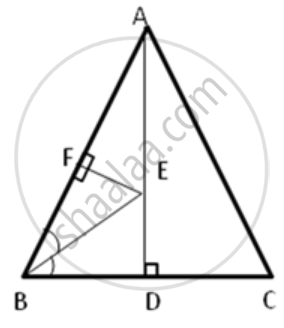
In the following figure, AB = AC and AD is perpendicular to BC. BE bisects angle B and EF is perpendicular to AB.
Prove that : ED = EF
In the following figure, AB = EF, BC = DE and ∠B = ∠E = 90°.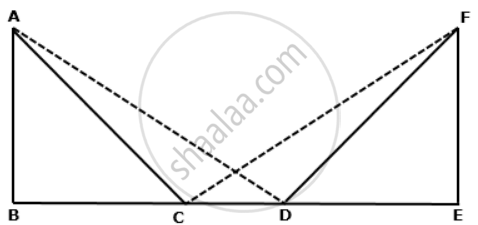
Prove that AD = FC.
ABC is a right triangle with AB = AC. Bisector of ∠A meets BC at D. Prove that BC = 2AD.
