Advertisements
Advertisements
प्रश्न
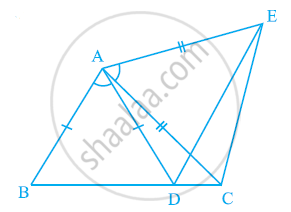
In the given figure, AC = AE, AB = AD and ∠BAD = ∠EAC. Show that BC = DE.
Advertisements
उत्तर
Given that
∠BAD = ∠EAC
On adding ∠DAC on both sides, we get
∠BAD + ∠DAC = ∠EAC + ∠DAC
⇒ ∠BAC = ∠EAD …(I)
Now, in △ABC and △AED,
AB = AD ...[Given]
AC = AE ...[Given]
∠BAC = ∠EAD ...[By (I)]
∴ △ABC ≌ △ADE ...[By AAS congruence rule]
⇒ BC = DE ...[Corresponding parts of congruent triangles]
APPEARS IN
संबंधित प्रश्न
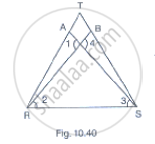
In Fig. 10.40, it is given that RT = TS, ∠1 = 2∠2 and ∠4 = 2∠3. Prove that ΔRBT ≅ ΔSAT.
In a triangle ABC, D is mid-point of BC; AD is produced up to E so that DE = AD. Prove that:
AB = CE.
In a triangle ABC, D is mid-point of BC; AD is produced up to E so that DE = AD. Prove that:
AB is parallel to EC.
A triangle ABC has ∠B = ∠C.
Prove that: The perpendiculars from the mid-point of BC to AB and AC are equal.
In ∆ABC, AB = AC. Show that the altitude AD is median also.
In the following figure, BL = CM.
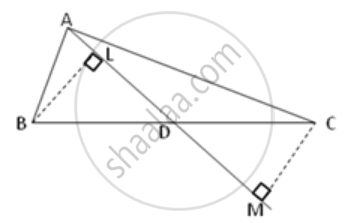
Prove that AD is a median of triangle ABC.
ABCD is a parallelogram. The sides AB and AD are produced to E and F respectively, such produced to E and F respectively, such that AB = BE and AD = DF.
Prove that: ΔBEC ≅ ΔDCF.
In the parallelogram ABCD, the angles A and C are obtuse. Points X and Y are taken on the diagonal BD such that the angles XAD and YCB are right angles.
Prove that: XA = YC.
In the figure, given below, triangle ABC is right-angled at B. ABPQ and ACRS are squares. 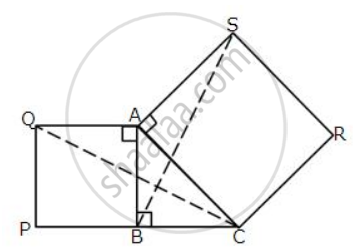
Prove that:
(i) ΔACQ and ΔASB are congruent.
(ii) CQ = BS.
AD and BC are equal perpendiculars to a line segment AB. If AD and BC are on different sides of AB prove that CD bisects AB.
