Advertisements
Advertisements
Question
In the following diagram, ABCD is a square and APB is an equilateral triangle.
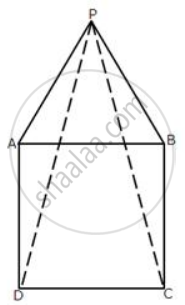
- Prove that: ΔAPD ≅ ΔBPC
- Find the angles of ΔDPC.
Advertisements
Solution
Given: ABCD is a Square and ΔAPB is an equilateral triangle.
(i) Proof: In ΔAPB,
AP = PB = AB ...[APB is an equilateral triangle]
Also, we have,
∠PBA = ∠PAB = ∠APB = 60° ...(1)
Since ABCD is a square, we have
∠A = ∠B = ∠C = ∠D = 90° ...(2)
Since ∠DAP = ∠A + ∠PAB ...(3)
⇒ ∠DAP = 90° + 60°
⇒ ∠DAP = 150° ...[From (1) and (2)] ...(4)
Similarly ∠CBP = ∠B + ∠PBA
⇒ ∠CBP = 90° + 60°
⇒ ∠CBP = 150° ...[From (1) and (2)] ...(5)
⇒ ∠DAP = ∠CBP ...[From (1) and (2)] ...(6)
In ΔAPD and ΔBPC
AD = BC ...[Sides of square ABCD]
∠DAP = ∠CBP ...[From (6)]
AP = BP ...[Sides of equilateral ΔAPB]
∴ By Side-Angel-Side Criterion of Congruence, we have,
ΔAPD ≅ ΔBPC
(ii)
AP = PB = AB ...[ΔAPB is an equilateral triangle] ...(7)
AB = BC = CD = DA ...[Sides of square ABCD] ...(8)
From (7) and (8), we have
AP = DA and PB = BC ...(9)
In ΔAPD,
AP = DA ...[From (9)]
∠ADP = ∠APD ...[Angel opposite to equal sides are equal] ...(10)
∠ADP + ∠APD + ∠DAP = 180° ...[Sum of angel of a triangle = 180°]
⇒ ∠ADP + ∠ADP + 150° = 180° ...[From (3), ∠DAP = 150° From (10), ∠ADP = ∠APD]
⇒ ∠ADP + ∠ADP = 180° - 150°
⇒ 2∠ADP = 30°
⇒ ∠ADP = `30^circ/2`
⇒∠ADP= 15°
We have ∠PDC =∠D - ∠ADP
⇒ ∠PDC = 90° - 15°
⇒ ∠PDC = 75° ...(11)
In ΔBPC,
PB = BC ...[From (9)]
∴ ∠PCB = ∠BPC ...[Angel opposite to equal sides are equal] ...(12)
∠PCB + ∠BPC + ∠CBP = 180° ...[Sum of angel of a triangle = 180°]
⇒ ∠PCB + ∠PCB + 30° = 180° ...[From (5), ∠CBP = 150° from (12), ∠PCB = ∠BPC]
⇒ 2∠PCB = 180° - 150°
⇒ 2∠PCB = `30^circ/2`
⇒ ∠PCB = 15°
We have ∠PCD = ∠C - ∠PCB
⇒ ∠PCD = 90° - 15°
⇒ ∠PCD = 75° ...(13)
In ΔDPC,
∠PDC = 75°
∠PCD = 75°
∠PCD + ∠PDC + ∠DPC = 180° ...[Sum of angles of a triangle = 180°]
⇒ 75° + 75° + ∠DPC = 180°
⇒ ∠DPC = 180° - 150°
⇒ ∠DPC = 30°
∴ Angles of DPC, are: 75°, 30°, 75°
