Advertisements
Advertisements
Question
In the figure, given below, triangle ABC is right-angled at B. ABPQ and ACRS are squares. 
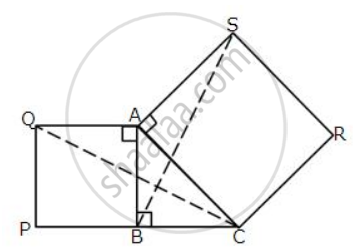
Prove that:
(i) ΔACQ and ΔASB are congruent.
(ii) CQ = BS.
Advertisements
Solution
Given: A(Δ ABC) is right-angled at B.
ABPQ and ACRS are squares
To Prove:
(i) ΔACQ ≅ ΔASB
(ii) CQ = BS
Proof:
(i)
∠ QAB = 90° ...[ ABPQ is a square ] ...(1)
∠ CAS = 90° ...[ ACRS is a square ] ...(2)
From (1) and (2) , We have
∠ QAB = ∠CAS ...(3)
Adding ∠BAC to both sides of (3), We have
∠ QAB + ∠BAC = ∠CAS+ ∠BAC
⇒ ∠QAC = ∠BAS ...(4)
In ΔACQ ≅ ΔASB, (by SAS)
QA = AB ...[ Sides of a square ABPQ ]
∠QAC = ∠SAB ...[ From(4) ]
AC = AS ...[ sides of a square ACRS ]
∴ By Side -Angle-Side criterion of congruence,
ΔACQ ≅ ΔASB
(ii)
The corresponding parts of the congruent triangles are congruent,
∴ CQ = SB ...[ c.p.c.t. ]
APPEARS IN
RELATED QUESTIONS
In quadrilateral ACBD, AC = AD and AB bisects ∠A (See the given figure). Show that ΔABC ≅ ΔABD. What can you say about BC and BD?

You want to show that ΔART ≅ ΔPEN,
If you have to use SSS criterion, then you need to show
1) AR =
2) RT =
3) AT =

In the figure, the two triangles are congruent.
The corresponding parts are marked. We can write ΔRAT ≅ ?

In Fig. 10.40, it is given that RT = TS, ∠1 = 2∠2 and ∠4 = 2∠3. Prove that ΔRBT ≅ ΔSAT.
In Fig. 10.92, it is given that AB = CD and AD = BC. Prove that ΔADC ≅ ΔCBA.
If perpendiculars from any point within an angle on its arms are congruent, prove that it lies on the bisector of that angle.
In a triangle ABC, D is mid-point of BC; AD is produced up to E so that DE = AD.
Prove that :
(i) ΔABD and ΔECD are congruent.
(ii) AB = CE.
(iii) AB is parallel to EC
A line segment AB is bisected at point P and through point P another line segment PQ, which is perpendicular to AB, is drawn. Show that: QA = QB.
From the given diagram, in which ABCD is a parallelogram, ABL is a line segment and E is mid-point of BC.
Prove that: AB = BL.
In a triangle, ABC, AB = BC, AD is perpendicular to side BC and CE is perpendicular to side AB.
Prove that: AD = CE.
