Advertisements
Advertisements
Question
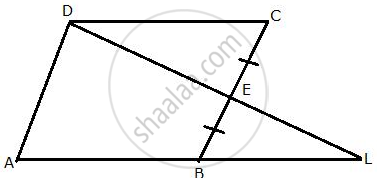
From the given diagram, in which ABCD is a parallelogram, ABL is a line segment and E is mid-point of BC.
Prove that:
(i) ΔDCE ≅ ΔLBE
(ii) AB = BL.
(iii) AL = 2DC
Advertisements
Solution
Given: ABCD is a parallelogram in which is the mid-point of BC.
We need to prove that
(i) ΔDCE ≅ ΔLBE
(ii) AB = BL.
(iii) AL = 2DC
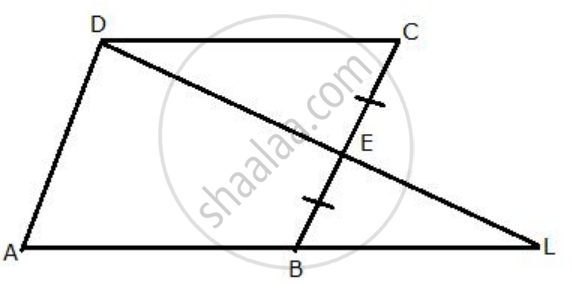
(i) In ΔDCE and ΔLBE
∠DCE = ∠EBL ...[DC || AB, alternate angels]
CE = EB ...[ E is the midpoint of BC]
∠DEC= ∠LEB ...[ vertically opposite angels]
∴ By Angel-SIde-Angel Criterion of congruence, we have,
ΔDCE ≅ ΔLBE
The corresponding parts of the congruent triangles are congruent.
∴ DC= LB ...[ c. p. c .t] ....(1)
(ii) DC= AB ...[ opposite sides of a parallelogram]...(2)
From ( 1 ) and ( 2 ), Ab = BL ...(3)
(iii) Al = AB+ BL ... (4)
From (3) and (4), Al = AB + AB
⇒AL = 2AB
⇒AL = 2DC ...[ From (2) ]
APPEARS IN
RELATED QUESTIONS
Line l is the bisector of an angle ∠A and B is any point on l. BP and BQ are perpendiculars from B to the arms of ∠A (see the given figure). Show that:
- ΔAPB ≅ ΔAQB
- BP = BQ or B is equidistant from the arms of ∠A.

In right triangle ABC, right angled at C, M is the mid-point of hypotenuse AB. C is joined to M and produced to a point D such that DM = CM. Point D is joined to point B (see the given figure). Show that:
- ΔAMC ≅ ΔBMD
- ∠DBC is a right angle.
- ΔDBC ≅ ΔACB
- CM = `1/2` AB

Which congruence criterion do you use in the following?
Given: EB = DB
AE = BC
∠A = ∠C = 90°
So, ΔABE ≅ ΔCDB

You want to show that ΔART ≅ ΔPEN,
If it is given that ∠T = ∠N and you are to use SAS criterion, you need to have
1) RT = and
2) PN =

If ABC and DEF are two triangles such that AC = 2.5 cm, BC = 5 cm, ∠C = 75°, DE = 2.5 cm, DF = 5cm and ∠D = 75°. Are two triangles congruent?
In two triangles ABC and ADC, if AB = AD and BC = CD. Are they congruent?
If the following pair of the triangle is congruent? state the condition of congruency:
In ΔABC and ΔQRP, AB = QR, ∠B = ∠R and ∠C = P.
In a triangle ABC, D is mid-point of BC; AD is produced up to E so that DE = AD.
Prove that :
(i) ΔABD and ΔECD are congruent.
(ii) AB = CE.
(iii) AB is parallel to EC
In quadrilateral ABCD, AD = BC and BD = CA.
Prove that:
(i) ∠ADB = ∠BCA
(ii) ∠DAB = ∠CBA
In ΔABC, AB = AC and the bisectors of angles B and C intersect at point O.
Prove that : (i) BO = CO
(ii) AO bisects angle BAC.
