Advertisements
Advertisements
प्रश्न
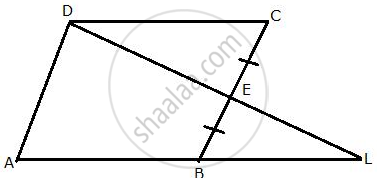
From the given diagram, in which ABCD is a parallelogram, ABL is a line segment and E is mid-point of BC.
Prove that:
(i) ΔDCE ≅ ΔLBE
(ii) AB = BL.
(iii) AL = 2DC
Advertisements
उत्तर
Given: ABCD is a parallelogram in which is the mid-point of BC.
We need to prove that
(i) ΔDCE ≅ ΔLBE
(ii) AB = BL.
(iii) AL = 2DC
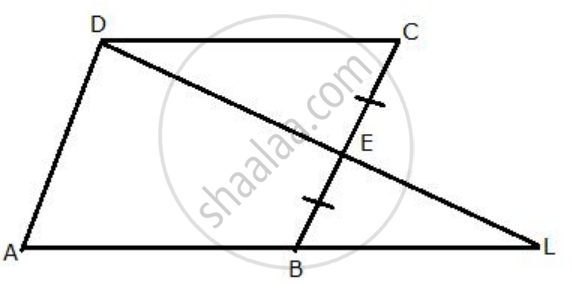
(i) In ΔDCE and ΔLBE
∠DCE = ∠EBL ...[DC || AB, alternate angels]
CE = EB ...[ E is the midpoint of BC]
∠DEC= ∠LEB ...[ vertically opposite angels]
∴ By Angel-SIde-Angel Criterion of congruence, we have,
ΔDCE ≅ ΔLBE
The corresponding parts of the congruent triangles are congruent.
∴ DC= LB ...[ c. p. c .t] ....(1)
(ii) DC= AB ...[ opposite sides of a parallelogram]...(2)
From ( 1 ) and ( 2 ), Ab = BL ...(3)
(iii) Al = AB+ BL ... (4)
From (3) and (4), Al = AB + AB
⇒AL = 2AB
⇒AL = 2DC ...[ From (2) ]
APPEARS IN
संबंधित प्रश्न
l and m are two parallel lines intersected by another pair of parallel lines p and q (see the given figure). Show that ΔABC ≅ ΔCDA.

Which congruence criterion do you use in the following?
Given: AC = DF
AB = DE
BC = EF
So, ΔABC ≅ ΔDEF

You want to show that ΔART ≅ ΔPEN,
If you have to use SSS criterion, then you need to show
1) AR =
2) RT =
3) AT =

Which of the following statements are true (T) and which are false (F):
Two right triangles are congruent if hypotenuse and a side of one triangle are respectively equal equal to the hypotenuse and a side of the other triangle.
D, E, F are the mid-point of the sides BC, CA and AB respectively of ΔABC. Then ΔDEF is congruent to triangle
If the following pair of the triangle is congruent? state the condition of congruency:
In ΔABC and ΔPQR, AB = PQ, AC = PR, and BC = QR.
In a triangle ABC, D is mid-point of BC; AD is produced up to E so that DE = AD. Prove that:
AB = CE.
In the following diagram, ABCD is a square and APB is an equilateral triangle.

- Prove that: ΔAPD ≅ ΔBPC
- Find the angles of ΔDPC.
In the following figure, ∠A = ∠C and AB = BC.
Prove that ΔABD ≅ ΔCBE. 
In the following figure, ABC is an equilateral triangle in which QP is parallel to AC. Side AC is produced up to point R so that CR = BP.
Prove that QR bisects PC.
Hint: ( Show that ∆ QBP is equilateral
⇒ BP = PQ, but BP = CR
⇒ PQ = CR ⇒ ∆ QPM ≅ ∆ RCM ).
