Advertisements
Advertisements
प्रश्न
In the following figure, ABC is an equilateral triangle in which QP is parallel to AC. Side AC is produced up to point R so that CR = BP.
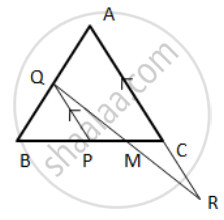
Prove that QR bisects PC.
Hint: ( Show that ∆ QBP is equilateral
⇒ BP = PQ, but BP = CR
⇒ PQ = CR ⇒ ∆ QPM ≅ ∆ RCM ).
Advertisements
उत्तर
ΔABC is an equilateral triangle,
So, each of its angles equals 60°.
QP is parallel to AC,
⇒ ∠PQB = ∠RAQ = 60°
ln ΔQBP,
∠PQB = ∠BQP = 60°
So, ∠PBQ + ∠BQP + ∠BPQ = 180° ....(angle sum property)
⇒ 60°+ 60° + ∠BPQ = 180°
⇒ ∠BPQ = 60°
So, ΔBPQ is an equilateral triangle.
⇒ QP = BP
⇒ QP = CR ....(i)
Now, ∠QPM + ∠BPQ = 180° ...(linear pair)
⇒ ∠QPM+ 60°= 180°
⇒ ∠QPM = 120°
Also, ∠RCM+ ∠ACB = 180° ...(linear pair)
⇒ ∠RCM+ 60° = 180°
⇒ ∠RCM = 120°
ln ΔRCM and ΔQMP,
∠RCM = ∠QPM ....(each is 120°)
∠RMC = ∠QMP ...(vertically opposite angles)
QP= CR ....(from(i))
⇒ ΔRCM ≅ ΔQMP ....(AAS congruence criterion)
So, CM = PM
⇒ QR bisects PC.
APPEARS IN
संबंधित प्रश्न
AD and BC are equal perpendiculars to a line segment AB (See the given figure). Show that CD bisects AB.

Which congruence criterion do you use in the following?
Given: EB = DB
AE = BC
∠A = ∠C = 90°
So, ΔABE ≅ ΔCDB

You want to show that ΔART ≅ ΔPEN,
If it is given that ∠T = ∠N and you are to use SAS criterion, you need to have
1) RT = and
2) PN =

In Fig. 10.92, it is given that AB = CD and AD = BC. Prove that ΔADC ≅ ΔCBA.
Which of the following statements are true (T) and which are false (F):
If any two sides of a right triangle are respectively equal to two sides of other right triangle, then the two triangles are congruent.
In triangles ABC and CDE, if AC = CE, BC = CD, ∠A = 60°, ∠C = 30° and ∠D = 90°. Are two triangles congruent?
The given figure shows a circle with center O. P is mid-point of chord AB.

Show that OP is perpendicular to AB.
If AP bisects angle BAC and M is any point on AP, prove that the perpendiculars drawn from M to AB and AC are equal.
In quadrilateral ABCD, AD = BC and BD = CA.
Prove that:
(i) ∠ADB = ∠BCA
(ii) ∠DAB = ∠CBA
In the following figure, OA = OC and AB = BC.
Prove that: ΔAOD≅ ΔCOD
