हिंदी

In the Following Figure, Abc is an Equilateral Triangle in Which Qp is Parallel to Ac. Side Ac is Produced up to Point R So that Cr = Bp.Prove that Qr Bisects Pc. - Mathematics

Advertisements
Advertisements

प्रश्न

In the following figure, ABC is an equilateral triangle in which QP is parallel to AC. Side AC is produced up to point R so that CR = BP.
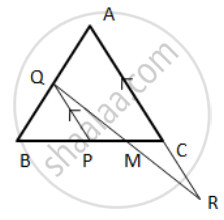
Prove that QR bisects PC.
Hint: ( Show that ∆ QBP is equilateral
⇒ BP = PQ, but BP = CR
⇒ PQ = CR ⇒ ∆ QPM ≅ ∆ RCM ).

योग
Advertisements

उत्तर

ΔABC is an equilateral triangle,
So, each of its angles equals 60°.
QP is parallel to AC,
⇒ ∠PQB = ∠RAQ = 60°
ln ΔQBP,
∠PQB = ∠BQP = 60°
So, ∠PBQ + ∠BQP + ∠BPQ = 180°   ....(angle sum property)
⇒ 60°+ 60° + ∠BPQ = 180°
⇒ ∠BPQ = 60°
So, ΔBPQ is an equilateral triangle.
⇒ QP = BP 
⇒ QP = CR                                ....(i)
Now, ∠QPM + ∠BPQ = 180°    ...(linear pair)
⇒ ∠QPM+ 60°= 180°
⇒ ∠QPM = 120°
Also, ∠RCM+ ∠ACB = 180°       ...(linear pair)
⇒ ∠RCM+ 60° = 180°
⇒ ∠RCM = 120°
ln ΔRCM and ΔQMP,
∠RCM = ∠QPM                        ....(each is 120°)
∠RMC = ∠QMP                   ...(vertically opposite angles)
QP= CR                                   ....(from(i))
⇒ ΔRCM ≅ ΔQMP  ....(AAS congruence criterion)
So, CM = PM
⇒ QR bisects PC.

shaalaa.com
Criteria for Congruence of Triangles
  क्या इस प्रश्न या उत्तर में कोई त्रुटि है?
अध्याय 9: Triangles [Congruency in Triangles] - Exercise 9 (B) [पृष्ठ १२६]

APPEARS IN

सेलिना Concise Mathematics [English] Class 9 ICSE
अध्याय 9 Triangles [Congruency in Triangles]
Exercise 9 (B) | Q 14 | पृष्ठ १२६

संबंधित प्रश्न

In right triangle ABC, right angled at C, M is the mid-point of hypotenuse AB. C is joined to M and produced to a point D such that DM = CM. Point D is joined to point B (see the given figure). Show that:

  1. ΔAMC ≅ ΔBMD
  2. ∠DBC is a right angle.
  3. ΔDBC ≅ ΔACB
  4. CM = `1/2` AB


Which congruence criterion do you use in the following?

Given: EB = DB

AE = BC

∠A = ∠C = 90°

So, ΔABE ≅ ΔCDB


You want to show that ΔART ≅ ΔPEN,

If you have to use SSS criterion, then you need to show

1) AR =

2) RT =

3) AT =


You want to show that ΔART ≅ ΔPEN,

If it is given that AT = PN and you are to use ASA criterion, you need to have

1) ?

2) ?


ABC is an isosceles triangle in which AB = AC. BE and CF are its two medians. Show that BE = CF.


In a triangle ABC, D is mid-point of BC; AD is produced up to E so that DE = AD.
Prove that :
(i) ΔABD and ΔECD are congruent. 
(ii) AB = CE.
(iii) AB is parallel to EC


A triangle ABC has ∠B = ∠C.
Prove that: The perpendiculars from the mid-point of BC to AB and AC are equal.


In the parallelogram ABCD, the angles A and C are obtuse. Points X and Y are taken on the diagonal BD such that the angles XAD and YCB are right angles.
Prove that: XA = YC.


In the adjoining figure, QX and RX are the bisectors of the angles Q and R respectively of the triangle PQR.
If XS ⊥ QR and XT ⊥  PQ;


Prove that:

  1. ΔXTQ ≅ ΔXSQ.
  2. PX bisects angle P.

ABC is a right triangle with AB = AC. Bisector of ∠A meets BC at D. Prove that BC = 2AD.


Share
Notifications

Englishहिंदीमराठी


      Forgot password?
Use app×