Advertisements
Advertisements
प्रश्न
ABC is an isosceles triangle in which AB = AC. BE and CF are its two medians. Show that BE = CF.
Advertisements
उत्तर
In the triangle ABC it is given that
AB = AC, BE and CFare medians.
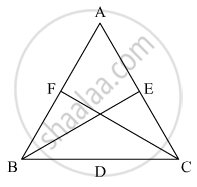
We have to show that BE CF
To show BF = CF we will show that ΔBFC ≅ ΔBEC
In triangle ΔBFC and ΔBEC
As AB = AC, so
∠FBC = ∠ECF .........(1)
BC=BC (common sides) ........(2)
Since,
AB = AC
`1/2 AB =1/2 AC `
As F and E are mid points of sides AB and AC respectively, so
BF = CE ..........(3)
From equation (1), (2), and (3)
ΔBFC and ΔBEC
Hence FC = BE Proved.
APPEARS IN
संबंधित प्रश्न
In right triangle ABC, right angled at C, M is the mid-point of hypotenuse AB. C is joined to M and produced to a point D such that DM = CM. Point D is joined to point B (see the given figure). Show that:
- ΔAMC ≅ ΔBMD
- ∠DBC is a right angle.
- ΔDBC ≅ ΔACB
- CM = `1/2` AB

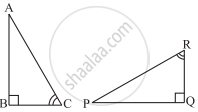
In ΔABC, ∠A = 30°, ∠B = 40° and ∠C = 110°
In ΔPQR, ∠P = 30°, ∠Q = 40° and ∠R = 110°
A student says that ΔABC ≅ ΔPQR by AAA congruence criterion. Is he justified? Why or why not?
If ΔABC and ΔPQR are to be congruent, name one additional pair of corresponding parts. What criterion did you use?
In a triangle ABC, D is mid-point of BC; AD is produced up to E so that DE = AD. Prove that:
AB = CE.
The perpendicular bisectors of the sides of a triangle ABC meet at I.
Prove that: IA = IB = IC.
A point O is taken inside a rhombus ABCD such that its distance from the vertices B and D are equal. Show that AOC is a straight line.
In the following figure, OA = OC and AB = BC.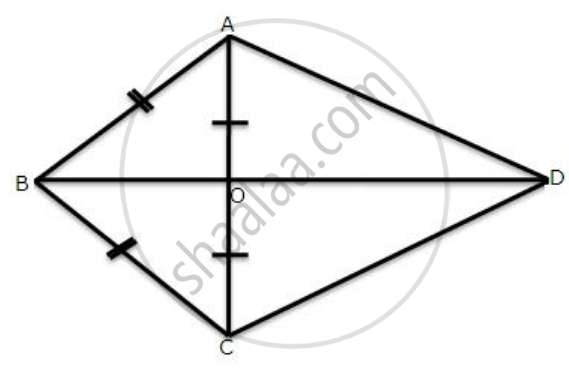
Prove that: ΔAOD≅ ΔCOD
In the following figure, AB = EF, BC = DE and ∠B = ∠E = 90°.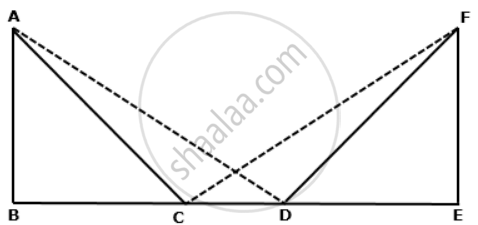
Prove that AD = FC.
In the following figure, ABC is an equilateral triangle in which QP is parallel to AC. Side AC is produced up to point R so that CR = BP.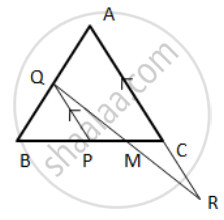
Prove that QR bisects PC.
Hint: ( Show that ∆ QBP is equilateral
⇒ BP = PQ, but BP = CR
⇒ PQ = CR ⇒ ∆ QPM ≅ ∆ RCM ).
ABC is a right triangle with AB = AC. Bisector of ∠A meets BC at D. Prove that BC = 2AD.
