Advertisements
Advertisements
प्रश्न
In ΔABC, AB = AC and the bisectors of angles B and C intersect at point O.
Prove that : (i) BO = CO
(ii) AO bisects angle BAC.
Advertisements
उत्तर

In ΔABC,
AB = AC
⇒ ∠B = ∠C ...( angles opposite to equal sides are equal )
⇒ `1/2 ∠"B" = 1/2∠"C"`
⇒ ∠OBC = ∠OCB ...[ ∵ OB and OC are bisectors of ∠B and ∠C respectively, ∠OBC = `1/2∠"B" and ∠"OCB" = 1/2∠"C"` ] ...(i)
⇒ OB = OC ...( Sides opposite to equal angles are equal ) ...(ii)
Now, in ΔABO and ΔACO,
AB = AC ...( given )
∠OBC = ∠OCB ...[ from(i) ]
OB = OC ...[ from(ii) ] ...( proved )
∴ ΔABO ≅ ΔACO ...( by SAS congruence criterion )
⇒ ∠BAO = ∠CAO ...( c.p.c.t. )
⇒ AO bisects ∠BAC ...(proved)
APPEARS IN
संबंधित प्रश्न
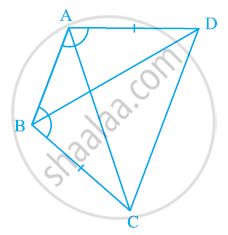
ABCD is a quadrilateral in which AD = BC and ∠DAB = ∠CBA (See the given figure). Prove that
- ΔABD ≅ ΔBAC
- BD = AC
- ∠ABD = ∠BAC.
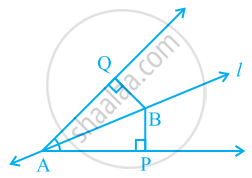
Line l is the bisector of an angle ∠A and B is any point on l. BP and BQ are perpendiculars from B to the arms of ∠A (see the given figure). Show that:
- ΔAPB ≅ ΔAQB
- BP = BQ or B is equidistant from the arms of ∠A.
If perpendiculars from any point within an angle on its arms are congruent, prove that it lies on the bisector of that angle.
A line segment AB is bisected at point P and through point P another line segment PQ, which is perpendicular to AB, is drawn. Show that: QA = QB.
If AP bisects angle BAC and M is any point on AP, prove that the perpendiculars drawn from M to AB and AC are equal.
In a ΔABC, BD is the median to the side AC, BD is produced to E such that BD = DE.
Prove that: AE is parallel to BC.
In the following diagram, ABCD is a square and APB is an equilateral triangle.
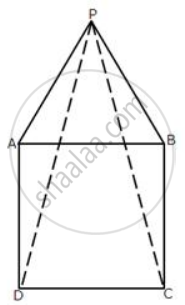
- Prove that: ΔAPD ≅ ΔBPC
- Find the angles of ΔDPC.
In the following figure, ABC is an equilateral triangle in which QP is parallel to AC. Side AC is produced up to point R so that CR = BP.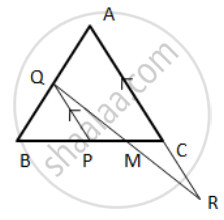
Prove that QR bisects PC.
Hint: ( Show that ∆ QBP is equilateral
⇒ BP = PQ, but BP = CR
⇒ PQ = CR ⇒ ∆ QPM ≅ ∆ RCM ).
PQRS is a parallelogram. L and M are points on PQ and SR respectively such that PL = MR.
Show that LM and QS bisect each other.
Which of the following is not a criterion for congruence of triangles?
