Advertisements
Advertisements
प्रश्न
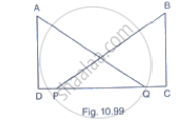
In Fig. 10.99, AD ⊥ CD and CB ⊥. CD. If AQ = BP and DP = CQ, prove that ∠DAQ = ∠CBP.
Advertisements
उत्तर
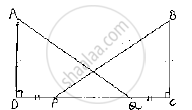
Given that, in the figure AD ⊥ CD and CB ⊥ CD and AQ = BP,DP =CQ
We have to prove that ∠DAQ=∠CBP
Given that DP= QC
Add PQ on both sides
Given that DP=QC
Add PQ on both sides
⇒ DP+PQ=PQ+QC
⇒ DQ=PC ................(1)
Now, consider triangle DAQ and CBP,
We have
∠ADQ=∠BCP=90° [given]
AQ=BP [given]
And DQ=PC [given]
So, by RHS congruence criterion, we have ΔDAQ≅ΔCBP
Now,
∠DAQ=∠CBP [ ∵Corresponding parts of congruent triangles are equal]
∴ Hence proved
APPEARS IN
संबंधित प्रश्न
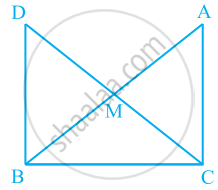
In right triangle ABC, right angled at C, M is the mid-point of hypotenuse AB. C is joined to M and produced to a point D such that DM = CM. Point D is joined to point B (see the given figure). Show that:
- ΔAMC ≅ ΔBMD
- ∠DBC is a right angle.
- ΔDBC ≅ ΔACB
- CM = `1/2` AB
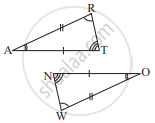
In the figure, the two triangles are congruent.
The corresponding parts are marked. We can write ΔRAT ≅ ?
ABCD is a square, X and Yare points on sides AD and BC respectively such that AY = BX. Prove that BY = AX and ∠BAY = ∠ABX.
D, E, F are the mid-point of the sides BC, CA and AB respectively of ΔABC. Then ΔDEF is congruent to triangle
If the following pair of the triangle is congruent? state the condition of congruency :
In Δ ABC and Δ DEF, AB = DE, BC = EF and ∠ B = ∠ E.
From the given diagram, in which ABCD is a parallelogram, ABL is a line segment and E is mid-point of BC.
prove that : AL = 2DC
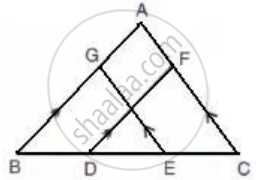
In the given figure: AB//FD, AC//GE and BD = CE;
prove that:
- BG = DF
- CF = EG
In the following figure, BL = CM.
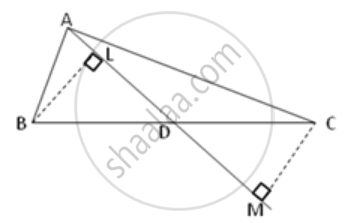
Prove that AD is a median of triangle ABC.
In the figure, given below, triangle ABC is right-angled at B. ABPQ and ACRS are squares. 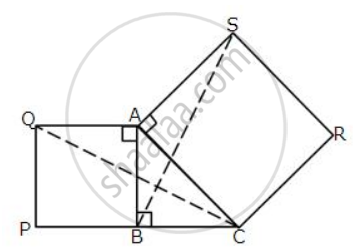
Prove that:
(i) ΔACQ and ΔASB are congruent.
(ii) CQ = BS.
AD and BC are equal perpendiculars to a line segment AB. If AD and BC are on different sides of AB prove that CD bisects AB.
