Advertisements
Advertisements
प्रश्न
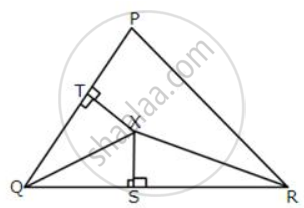
In the adjoining figure, QX and RX are the bisectors of the angles Q and R respectively of the triangle PQR.
If XS ⊥ QR and XT ⊥ PQ;
Prove that:
- ΔXTQ ≅ ΔXSQ.
- PX bisects angle P.
Advertisements
उत्तर
Given: A(ΔPQR) in which QX is the bisector of ∠Q and RX is the bisector of ∠R.
XS ⊥ QR and XT ⊥ PQ.
We need to prove that:
- ΔXTQ ≅ ΔXSQ.
- PX bisects angle P.
Construction: Draw XZ ⊥ PR and join PX.
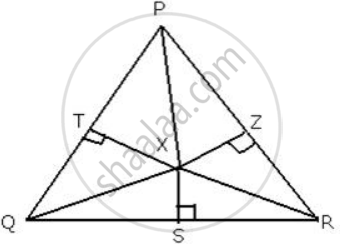
i. In ΔXTQ and ΔXSQ,
∠QTX = ∠QSX = 90° ...[XS ⊥ QR and XT ⊥ PQ]
∠TQX = ∠SQX ...[QX is bisector of ∠Q]
QX = QX ...[Common]
∴ By Angle-Side-Angle Criterion of congruence,
ΔXTQ ≅ ΔXSQ
ii. The corresponding parts of the congruent triangles are congruent.
∴ XT = XS ...[c.p.c.t.]
In ΔXSR and ΔXRZ
∠XSR = ∠XZR = 90° ...[XS ⊥ QR and ∠XSR = 90°]
∠XRS = ∠ZRX ...[RX is bisector of ∠R]
RX = RX ....[Common]
∴ By Angle-Angle-Side criterion of congruence,
ΔXSR ≅ ΔXRZ
The corresponding parts of the congruent triangles are congruent.
∴ XS = XT ...[c.p.c.t.]
From (1) and (2)
XT = XZ
In ΔXTP and ΔPZX
∠XTP = ∠XZP = 90° ....[Given]
XP = XP ....[Common]
XT = XZ
∴ By Right angle-Hypotenuse-side criterion of congruence,
ΔXTP ≅ ΔPZX
The corresponding parts of the congruent triangles are
congruent.
∴ ∠TPX = ∠ZPX ...[c.p.c.t.]
∴ PX bisects ∠P.
संबंधित प्रश्न
You want to show that ΔART ≅ ΔPEN,
If it is given that AT = PN and you are to use ASA criterion, you need to have
1) ?
2) ?

In ΔABC, ∠A = 30°, ∠B = 40° and ∠C = 110°
In ΔPQR, ∠P = 30°, ∠Q = 40° and ∠R = 110°
A student says that ΔABC ≅ ΔPQR by AAA congruence criterion. Is he justified? Why or why not?
In Fig. 10.92, it is given that AB = CD and AD = BC. Prove that ΔADC ≅ ΔCBA.
If perpendiculars from any point within an angle on its arms are congruent, prove that it lies on the bisector of that angle.
If the following pair of the triangle is congruent? state the condition of congruency:
In ΔABC and ΔQRP, AB = QR, ∠B = ∠R and ∠C = P.
In a triangle ABC, D is mid-point of BC; AD is produced up to E so that DE = AD.
Prove that :
(i) ΔABD and ΔECD are congruent.
(ii) AB = CE.
(iii) AB is parallel to EC
In the given figure, AB = DB and Ac = DC.

If ∠ ABD = 58o,
∠ DBC = (2x - 4)o,
∠ ACB = y + 15o and
∠ DCB = 63o ; find the values of x and y.
In the given figure: AB//FD, AC//GE and BD = CE;
prove that:
- BG = DF
- CF = EG

In the following figure, AB = AC and AD is perpendicular to BC. BE bisects angle B and EF is perpendicular to AB.
Prove that: BD = CD

AD and BC are equal perpendiculars to a line segment AB. If AD and BC are on different sides of AB prove that CD bisects AB.
