Advertisements
Advertisements
Question
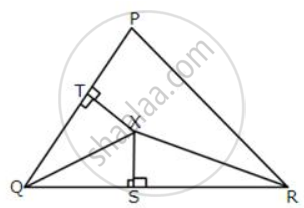
In the adjoining figure, QX and RX are the bisectors of the angles Q and R respectively of the triangle PQR.
If XS ⊥ QR and XT ⊥ PQ;
Prove that:
- ΔXTQ ≅ ΔXSQ.
- PX bisects angle P.
Advertisements
Solution
Given: A(ΔPQR) in which QX is the bisector of ∠Q and RX is the bisector of ∠R.
XS ⊥ QR and XT ⊥ PQ.
We need to prove that:
- ΔXTQ ≅ ΔXSQ.
- PX bisects angle P.
Construction: Draw XZ ⊥ PR and join PX.
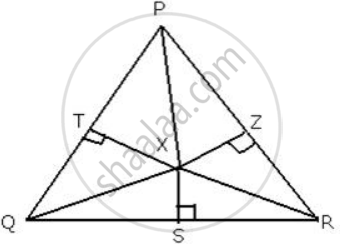
i. In ΔXTQ and ΔXSQ,
∠QTX = ∠QSX = 90° ...[XS ⊥ QR and XT ⊥ PQ]
∠TQX = ∠SQX ...[QX is bisector of ∠Q]
QX = QX ...[Common]
∴ By Angle-Side-Angle Criterion of congruence,
ΔXTQ ≅ ΔXSQ
ii. The corresponding parts of the congruent triangles are congruent.
∴ XT = XS ...[c.p.c.t.]
In ΔXSR and ΔXRZ
∠XSR = ∠XZR = 90° ...[XS ⊥ QR and ∠XSR = 90°]
∠XRS = ∠ZRX ...[RX is bisector of ∠R]
RX = RX ....[Common]
∴ By Angle-Angle-Side criterion of congruence,
ΔXSR ≅ ΔXRZ
The corresponding parts of the congruent triangles are congruent.
∴ XS = XT ...[c.p.c.t.]
From (1) and (2)
XT = XZ
In ΔXTP and ΔPZX
∠XTP = ∠XZP = 90° ....[Given]
XP = XP ....[Common]
XT = XZ
∴ By Right angle-Hypotenuse-side criterion of congruence,
ΔXTP ≅ ΔPZX
The corresponding parts of the congruent triangles are
congruent.
∴ ∠TPX = ∠ZPX ...[c.p.c.t.]
∴ PX bisects ∠P.
RELATED QUESTIONS
You want to show that ΔART ≅ ΔPEN,
If it is given that ∠T = ∠N and you are to use SAS criterion, you need to have
1) RT = and
2) PN =

In ΔABC, ∠A = 30°, ∠B = 40° and ∠C = 110°
In ΔPQR, ∠P = 30°, ∠Q = 40° and ∠R = 110°
A student says that ΔABC ≅ ΔPQR by AAA congruence criterion. Is he justified? Why or why not?
ABCD is a square, X and Yare points on sides AD and BC respectively such that AY = BX. Prove that BY = AX and ∠BAY = ∠ABX.
Which of the following statements are true (T) and which are false (F):
If any two sides of a right triangle are respectively equal to two sides of other right triangle, then the two triangles are congruent.
Prove that the perimeter of a triangle is greater than the sum of its altitudes.
In two triangles ABC and DEF, it is given that ∠A = ∠D, ∠B = ∠E and ∠C =∠F. Are the two triangles necessarily congruent?
The following figure shows a circle with center O.

If OP is perpendicular to AB, prove that AP = BP.
In a triangle ABC, D is mid-point of BC; AD is produced up to E so that DE = AD. Prove that:
AB is parallel to EC.
In ΔABC, AB = AC and the bisectors of angles B and C intersect at point O.
Prove that : (i) BO = CO
(ii) AO bisects angle BAC.
ABC is a right triangle with AB = AC. Bisector of ∠A meets BC at D. Prove that BC = 2AD.
