Advertisements
Advertisements
प्रश्न
In the parallelogram ABCD, the angles A and C are obtuse. Points X and Y are taken on the diagonal BD such that the angles XAD and YCB are right angles.
Prove that: XA = YC.
Advertisements
उत्तर
ABCD is a parallelogram in which ∠A and ∠C are obtuse.
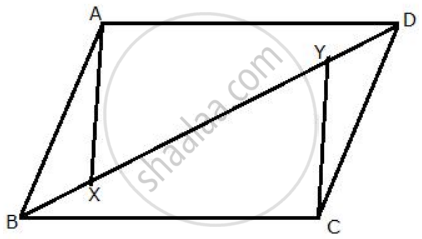
Points X and Y are taken on the diagonal BD.
Such that ∠XAD = ∠YCB = 90°.
We need to prove that XA = YC
Proof:
ln ΔXAD and ΔYCB
∠XAD = ∠YCB= 90° ...[ Given ]
AD = BC ...[ Opposite sides of a parallelogram ]
∠ADX = ∠CBY ...[ Alternate angles ]
∴ By Angle-Side-Angle criterion of congruence,
ΔXAD ≅ ΔYCB
The corresponding parts of the congruent triangles are congruent.
∴ XA = YC ...[ c.p.c.t. ]
Hence proved.
APPEARS IN
संबंधित प्रश्न
Which congruence criterion do you use in the following?
Given: EB = DB
AE = BC
∠A = ∠C = 90°
So, ΔABE ≅ ΔCDB

In two triangles ABC and DEF, it is given that ∠A = ∠D, ∠B = ∠E and ∠C =∠F. Are the two triangles necessarily congruent?
A triangle ABC has ∠B = ∠C.
Prove that: The perpendiculars from the mid-point of BC to AB and AC are equal.
A triangle ABC has ∠B = ∠C.
Prove that: The perpendiculars from B and C to the opposite sides are equal.
A line segment AB is bisected at point P and through point P another line segment PQ, which is perpendicular to AB, is drawn. Show that: QA = QB.
In the following figure, AB = AC and AD is perpendicular to BC. BE bisects angle B and EF is perpendicular to AB.
Prove that: BD = CD

ABCD is a parallelogram. The sides AB and AD are produced to E and F respectively, such produced to E and F respectively, such that AB = BE and AD = DF.
Prove that: ΔBEC ≅ ΔDCF.
In the following figure, OA = OC and AB = BC.
Prove that: ΔAOD≅ ΔCOD
In the following figure, ABC is an equilateral triangle in which QP is parallel to AC. Side AC is produced up to point R so that CR = BP.
Prove that QR bisects PC.
Hint: ( Show that ∆ QBP is equilateral
⇒ BP = PQ, but BP = CR
⇒ PQ = CR ⇒ ∆ QPM ≅ ∆ RCM ).
Which of the following is not a criterion for congruence of triangles?
