Advertisements
Advertisements
प्रश्न
D, E, F are the mid-point of the sides BC, CA and AB respectively of ΔABC. Then ΔDEF is congruent to triangle
विकल्प
ABC
AEF
BFD, CDE
AFE, BFD, CDE
Advertisements
उत्तर
It is given that D, E and Fare the mid points of the sides BC , CA and AB respectively of ΔABC
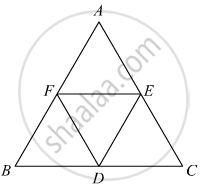
FE =BD (By mid point theorem)
BD = DC (As it is mid point)
Now in ΔAFE and ΔDFE
FE(Common)
DF = AE (Mid point)
AF = DE (Mid point)
⇒ ΔFED ≅ ΔBFD
⇒ ΔDFE ≅ ΔDCE
Hence (d)
ΔDFE ≅ AFE
≅ BFD
≅ CDE
APPEARS IN
संबंधित प्रश्न
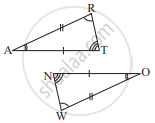
In the figure, the two triangles are congruent.
The corresponding parts are marked. We can write ΔRAT ≅ ?
A triangle ABC has ∠B = ∠C.
Prove that: The perpendiculars from B and C to the opposite sides are equal.
In the given figure, AB = DB and Ac = DC.
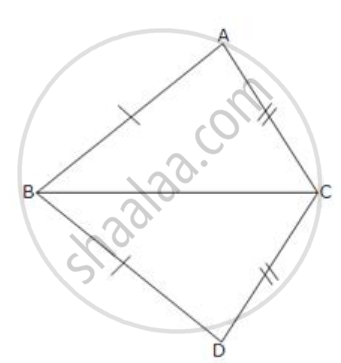
If ∠ ABD = 58o,
∠ DBC = (2x - 4)o,
∠ ACB = y + 15o and
∠ DCB = 63o ; find the values of x and y.
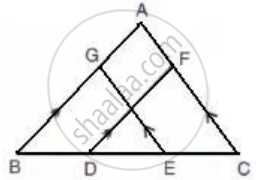
In the given figure: AB//FD, AC//GE and BD = CE;
prove that:
- BG = DF
- CF = EG
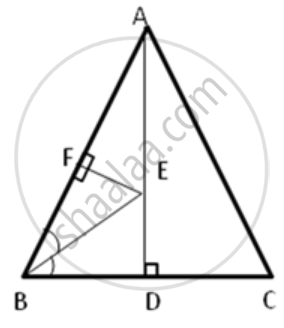
In the following figure, AB = AC and AD is perpendicular to BC. BE bisects angle B and EF is perpendicular to AB.
Prove that : ED = EF
ABCD is a parallelogram. The sides AB and AD are produced to E and F respectively, such produced to E and F respectively, such that AB = BE and AD = DF.
Prove that: ΔBEC ≅ ΔDCF.
In the parallelogram ABCD, the angles A and C are obtuse. Points X and Y are taken on the diagonal BD such that the angles XAD and YCB are right angles.
Prove that: XA = YC.
In the following figure, AB = EF, BC = DE and ∠B = ∠E = 90°.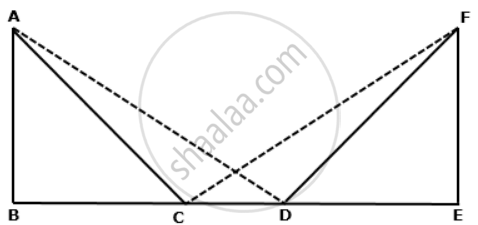
Prove that AD = FC.
In the following figure, ABC is an equilateral triangle in which QP is parallel to AC. Side AC is produced up to point R so that CR = BP.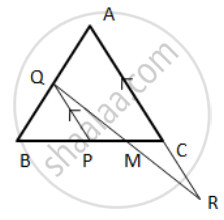
Prove that QR bisects PC.
Hint: ( Show that ∆ QBP is equilateral
⇒ BP = PQ, but BP = CR
⇒ PQ = CR ⇒ ∆ QPM ≅ ∆ RCM ).
ABC is an isosceles triangle with AB = AC and BD and CE are its two medians. Show that BD = CE.
