Advertisements
Advertisements
प्रश्न
In the figure, given below, triangle ABC is right-angled at B. ABPQ and ACRS are squares. 
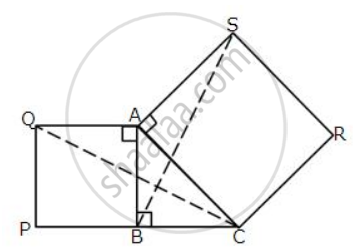
Prove that:
(i) ΔACQ and ΔASB are congruent.
(ii) CQ = BS.
Advertisements
उत्तर
Given: A(Δ ABC) is right-angled at B.
ABPQ and ACRS are squares
To Prove:
(i) ΔACQ ≅ ΔASB
(ii) CQ = BS
Proof:
(i)
∠ QAB = 90° ...[ ABPQ is a square ] ...(1)
∠ CAS = 90° ...[ ACRS is a square ] ...(2)
From (1) and (2) , We have
∠ QAB = ∠CAS ...(3)
Adding ∠BAC to both sides of (3), We have
∠ QAB + ∠BAC = ∠CAS+ ∠BAC
⇒ ∠QAC = ∠BAS ...(4)
In ΔACQ ≅ ΔASB, (by SAS)
QA = AB ...[ Sides of a square ABPQ ]
∠QAC = ∠SAB ...[ From(4) ]
AC = AS ...[ sides of a square ACRS ]
∴ By Side -Angle-Side criterion of congruence,
ΔACQ ≅ ΔASB
(ii)
The corresponding parts of the congruent triangles are congruent,
∴ CQ = SB ...[ c.p.c.t. ]
APPEARS IN
संबंधित प्रश्न
In quadrilateral ACBD, AC = AD and AB bisects ∠A (See the given figure). Show that ΔABC ≅ ΔABD. What can you say about BC and BD?

AB is a line segment and P is its mid-point. D and E are points on the same side of AB such that ∠BAD = ∠ABE and ∠EPA = ∠DPB (See the given figure). Show that
- ΔDAP ≅ ΔEBP
- AD = BE

In right triangle ABC, right angled at C, M is the mid-point of hypotenuse AB. C is joined to M and produced to a point D such that DM = CM. Point D is joined to point B (see the given figure). Show that:
- ΔAMC ≅ ΔBMD
- ∠DBC is a right angle.
- ΔDBC ≅ ΔACB
- CM = `1/2` AB

Which congruence criterion do you use in the following?
Given: ∠MLN = ∠FGH
∠NML = ∠GFH
ML = FG
So, ΔLMN ≅ ΔGFH

In Fig. 10.99, AD ⊥ CD and CB ⊥. CD. If AQ = BP and DP = CQ, prove that ∠DAQ = ∠CBP.
Prove that the perimeter of a triangle is greater than the sum of its altitudes.
In the given figure, prove that:
CD + DA + AB + BC > 2AC

In the parallelogram ABCD, the angles A and C are obtuse. Points X and Y are taken on the diagonal BD such that the angles XAD and YCB are right angles.
Prove that: XA = YC.
In ΔABC, AB = AC and the bisectors of angles B and C intersect at point O.
Prove that : (i) BO = CO
(ii) AO bisects angle BAC.
In the following figure, ∠A = ∠C and AB = BC.
Prove that ΔABD ≅ ΔCBE. 
