Advertisements
Advertisements
प्रश्न
Prove that the perimeter of a triangle is greater than the sum of its altitudes.
Advertisements
उत्तर
We have to prove that the perimeter of a triangle is greater than the sum of its altitude.
In ΔABC
AD⊥ BC , BE ⊥ AC , CF⊥AB
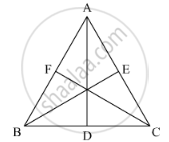
We have to prove
AB + BC + CD > AD + BE + CF
Since AD⊥ BC
So AB > AD and AC > AD
By adding AB + AC > AD + AD, we have
AB + AC > 2AD ........(1)
Now consider BE ⊥ AC then
BC > BE, and BA > BE
Now by adding BC + BA > 2BE .......(2)
Again consider CF⊥AB
AC > CF, and BC > CF
By adding AC + BC > 2CF ...........(3)
Adding (1), (2) and (3), we get
2(AB + BC + CA)>2 (AD + BE + CF)
⇒ AB + BC + CA > AD + BE + CF
Hence the perimeter of a triangle is greater than the sum of all its altitude.
APPEARS IN
संबंधित प्रश्न
In the given figure, AC = AE, AB = AD and ∠BAD = ∠EAC. Show that BC = DE.
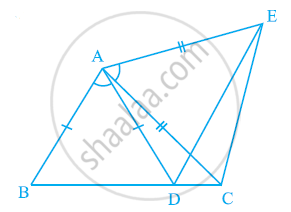
In right triangle ABC, right angled at C, M is the mid-point of hypotenuse AB. C is joined to M and produced to a point D such that DM = CM. Point D is joined to point B (see the given figure). Show that:
- ΔAMC ≅ ΔBMD
- ∠DBC is a right angle.
- ΔDBC ≅ ΔACB
- CM = `1/2` AB

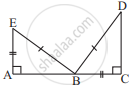
Which congruence criterion do you use in the following?
Given: EB = DB
AE = BC
∠A = ∠C = 90°
So, ΔABE ≅ ΔCDB
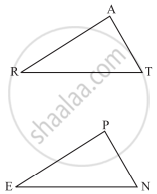
You want to show that ΔART ≅ ΔPEN,
If you have to use SSS criterion, then you need to show
1) AR =
2) RT =
3) AT =
If perpendiculars from any point within an angle on its arms are congruent, prove that it lies on the bisector of that angle.
Which of the following statements are true (T) and which are false (F):
Two right triangles are congruent if hypotenuse and a side of one triangle are respectively equal equal to the hypotenuse and a side of the other triangle.
In Δ ABC, ∠B = 35°, ∠C = 65° and the bisector of ∠BAC meets BC in P. Arrange AP, BP and CP in descending order.
ABCD is a parallelogram. The sides AB and AD are produced to E and F respectively, such produced to E and F respectively, such that AB = BE and AD = DF.
Prove that: ΔBEC ≅ ΔDCF.
In the following figure, ABC is an equilateral triangle in which QP is parallel to AC. Side AC is produced up to point R so that CR = BP.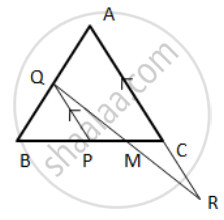
Prove that QR bisects PC.
Hint: ( Show that ∆ QBP is equilateral
⇒ BP = PQ, but BP = CR
⇒ PQ = CR ⇒ ∆ QPM ≅ ∆ RCM ).
ABC is an isosceles triangle with AB = AC and BD and CE are its two medians. Show that BD = CE.
