Advertisements
Advertisements
Question
l and m are two parallel lines intersected by another pair of parallel lines p and q (see the given figure). Show that ΔABC ≅ ΔCDA.

Advertisements
Solution
l || m ...[Given]
AC is a transversal.
So, ∠DAC = ∠ACB ...[Alternate angles]
p || q ...[Given]
AC is a transversal.
So, ∠BAC = ∠ACD ...[Alternate angles]
Now, △ABC and △CDA,
∠ACB = ∠DAC ...[Proved above]
∠BAC = ∠ACD ...[Proved above]
AC = AC ...[Common]
△ABC ≌ △CDA ...[By AAS congruence rule]
APPEARS IN
RELATED QUESTIONS
ABCD is a quadrilateral in which AD = BC and ∠DAB = ∠CBA (See the given figure). Prove that
- ΔABD ≅ ΔBAC
- BD = AC
- ∠ABD = ∠BAC.

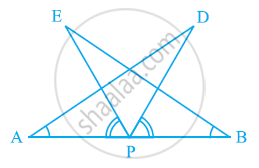
AB is a line segment and P is its mid-point. D and E are points on the same side of AB such that ∠BAD = ∠ABE and ∠EPA = ∠DPB (See the given figure). Show that
- ΔDAP ≅ ΔEBP
- AD = BE
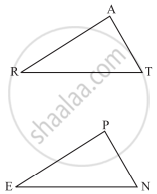
You want to show that ΔART ≅ ΔPEN,
If it is given that ∠T = ∠N and you are to use SAS criterion, you need to have
1) RT = and
2) PN =
In two triangles ABC and DEF, it is given that ∠A = ∠D, ∠B = ∠E and ∠C =∠F. Are the two triangles necessarily congruent?
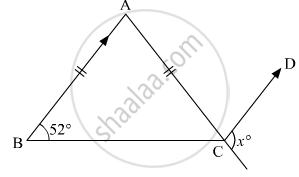
In the given figure, ABC is an isosceles triangle whose side AC is produced to E. Through C, CD is drawn parallel to BA. The value of x is
A triangle ABC has ∠B = ∠C.
Prove that: The perpendiculars from B and C to the opposite sides are equal.
In the given figure, AB = DB and Ac = DC.
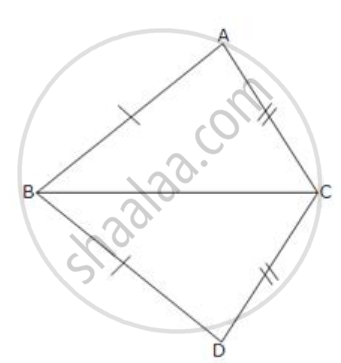
If ∠ ABD = 58o,
∠ DBC = (2x - 4)o,
∠ ACB = y + 15o and
∠ DCB = 63o ; find the values of x and y.
In the following diagram, ABCD is a square and APB is an equilateral triangle.
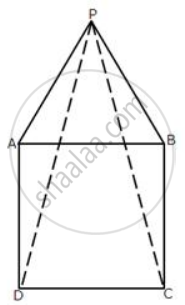
- Prove that: ΔAPD ≅ ΔBPC
- Find the angles of ΔDPC.
In the following figure, OA = OC and AB = BC.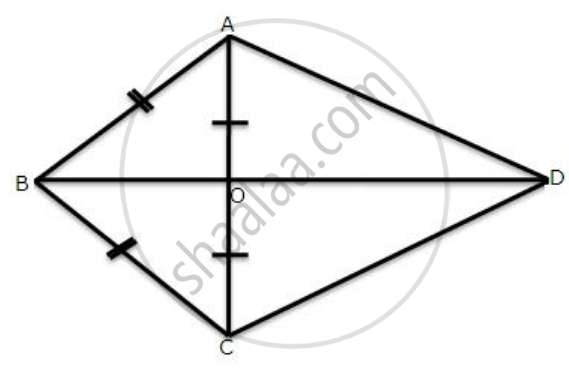
Prove that: ΔAOD≅ ΔCOD
AD and BC are equal perpendiculars to a line segment AB. If AD and BC are on different sides of AB prove that CD bisects AB.
