Advertisements
Advertisements
प्रश्न
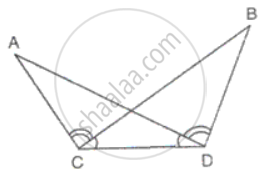
In the figure, ∠BCD = ∠ADC and ∠ACB =∠BDA. Prove that AD = BC and ∠A = ∠B.
Advertisements
उत्तर
∠BCD = ∠ADC
∠ACB = ∠BDA
∠BCD + ∠ACB = ∠ADC + ∠BDA
⇒ ∠ACD = ∠BDCACD = BDC
In ΔACD and ΔBCD
∠ACD =∠BDCACD = BDC
∠ADC = ∠BCD
ADC = BCD
CD = CD
Therefore, ΔACD ≅ ΔBCD ...(ASA criteria)
Hence, AD = BC and ∠A = ∠B.
APPEARS IN
संबंधित प्रश्न
If ΔDEF ≅ ΔBCA, write the part(s) of ΔBCA that correspond to `bar(EF)`
If ΔDEF ≅ ΔBCA, write the part(s) of ΔBCA that correspond to ∠F
In a ΔABC, if AB = AC and BC is produced to D such that ∠ACD = 100°, then ∠A =
If ABC and DEF are two triangles such that ΔABC \[\cong\] ΔFDE and AB = 5cm, ∠B = 40°
In the given figure, ABC is a triangle in which ∠B = 2∠C. D is a point on side BC such that ADbisects ∠BAC and AB = CD. BE is the bisector of ∠B. The measure of ∠BAC is

In ΔTPQ, ∠T = 65°, ∠P = 95° which of the following is a true statement?
In the following diagram, ABCD is a square and APB is an equilateral triangle.
(i) Prove that: ΔAPD≅ ΔBPC
(ii) Find the angles of ΔDPC.
In ΔABC, AB = AC, BM and Cn are perpendiculars on AC and AB respectively. Prove that BM = CN.
In the given figure, AB = DB and AC = DC. Find the values of x and y.
Is it possible to construct a triangle with lengths of its sides as 4 cm, 3 cm and 7 cm? Give reason for your answer.
