Advertisements
Advertisements
प्रश्न
Is it possible to construct a triangle with lengths of its sides as 4 cm, 3 cm and 7 cm? Give reason for your answer.
Advertisements
उत्तर
No, it is not possible to construct a triangle with lengths of its sides as 4 cm, 3 cm and 7 cm because here we see that sum of the lengths of two sides is equal to third side i.e., 4 + 3 = 7.
As we know that, the sum of any two sides of a triangle is greater than its third side, so given statement is not correct.
APPEARS IN
संबंधित प्रश्न
Find the measure of each angle of an equilateral triangle.
Prove that the sum of three altitudes of a triangle is less than the sum of its sides.
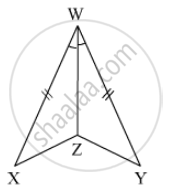
In the pair of triangles in the following figure, parts bearing identical marks are congruent. State the test and the correspondence of vertices by the triangle in pairs is congruent.
In a triangle, ABC, AB = BC, AD is perpendicular to side BC and CE is perpendicular to side AB. Prove that: AD = CE.
In a circle with center O. If OM is perpendicular to PQ, prove that PM = QM.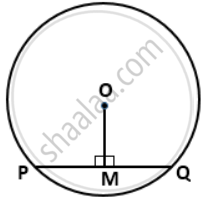
AD and BE are altitudes of an isosceles triangle ABC with AC = BC. Prove that AE = BD.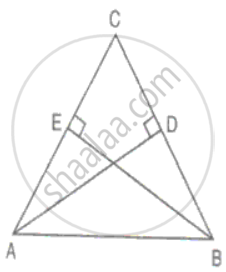
If the perpendicular bisector of the sides of a triangle PQR meet at I, then prove that the line joining from P, Q, R to I are equal.
O is any point in the ΔABC such that the perpendicular drawn from O on AB and AC are equal. Prove that OA is the bisector of ∠BAC.
PQRS is a quadrilateral and T and U are points on PS and RS respectively such that PQ = RQ, ∠PQT = ∠RQU and ∠TQS = ∠UQS. Prove that QT = QU.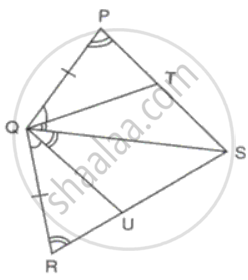
The congruent figures super impose each other completely.
