Advertisements
Advertisements
प्रश्न
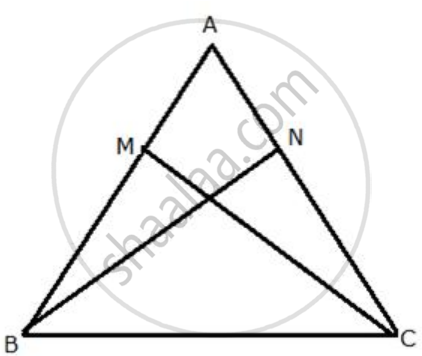
The following figure has shown a triangle ABC in which AB = AC. M is a point on AB and N is a point on AC such that BM = CN.
Prove that: (i) BN = CM (ii) ΔBMC ≅ ΔCNB
Advertisements
उत्तर
In ΔABC, AB = AC. m and N are points on
AB and AC such that BM = CN
BN and CM are joined

(i) The corresponding parts of the congruent triangles are congruent.
∴ CM = BN ...[ c.p.c.t ] ...(1)
(ii) Consider the triangles ΔBMC and ΔCNB
BM = CN ...[Given]
BC = BC ...[Common]
CM = BN ...[From (1)]
∴ By Side-Side-Side criterion of congruence, we have ΔBMC ≅ ΔCNB
APPEARS IN
संबंधित प्रश्न
Find the measure of each angle of an equilateral triangle.
In ΔTPQ, ∠T = 65°, ∠P = 95° which of the following is a true statement?
In the following figure, OA = OC and AB = BC.

Prove that: AD = CD
The following figure has shown a triangle ABC in which AB = AC. M is a point on AB and N is a point on AC such that BM = CN.
Prove that: (i) AM = AN (ii) ΔAMC ≅ ΔANB

The following figure shown a triangle ABC in which AB = AC. M is a point on AB and N is a point on AC such that BM = CN.
Prove that: ΔAMC≅ ΔANB

In ΔABC, AB = AC and the bisectors of angles B and C intersect at point O.Prove that BO = CO and the ray AO is the bisector of angle BAC.
“If two angles and a side of one triangle are equal to two angles and a side of another triangle, then the two triangles must be congruent.” Is the statement true? Why?
It is given that ∆ABC ≅ ∆RPQ. Is it true to say that BC = QR? Why?
If ∆PQR is congruent to ∆STU (see figure), then what is the length of TU?

Two figures are congruent, if they have the same shape.
