Advertisements
Advertisements
प्रश्न
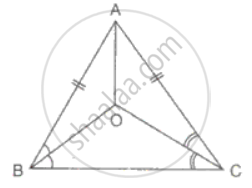
In ΔABC, AB = AC and the bisectors of angles B and C intersect at point O.Prove that BO = CO and the ray AO is the bisector of angle BAC.
Advertisements
उत्तर
In ΔABC,
Since AB = AC
∠C = ∠B ...(angles opposite to the equal sides are equal)
BO and CO are angle bisectors of ∠B and ∠C respectively
Hence, ∠ABO = ∠OBC = ∠BCO = ∠ACO
Join AO to meet BC at D
In ΔABO and ΔACO and
AO = AO
AB = AC
∠C = ∠B =
Therefore, ΔBAO ≅ ΔACO ...(SAS criteria)
Hence, ∠BAO = ∠CAO
⇒ AO bisects angle BAC
In ΔABO and ΔACO
and AB = AC
AO = AO
∠BAD = ∠CAD = ...(proved)
ΔBAO ≅ ΔACO ...(SAS criteria)
Therefore,
BO = CO.
APPEARS IN
संबंधित प्रश्न
In Fig. 10.22, the sides BA and CA have been produced such that: BA = AD and CA = AE.
Prove that segment DE || BC.
In an isosceles triangle, if the vertex angle is twice the sum of the base angles, then the measure of vertex angle of the triangle is
State, whether the pairs of triangles given in the following figures are congruent or not:

Prove that in an isosceles triangle the altitude from the vertex will bisect the base.
In ΔABC, AB = AC. D is a point in the interior of the triangle such that ∠DBC = ∠DCB. Prove that AD bisects ∠BAC of ΔABC.
In triangles ABC and PQR, ∠A = ∠Q and ∠B = ∠R. Which side of ∆PQR should be equal to side AB of ∆ABC so that the two triangles are congruent? Give reason for your answer.
“If two sides and an angle of one triangle are equal to two sides and an angle of another triangle, then the two triangles must be congruent.” Is the statement true? Why?
Is it possible to construct a triangle with lengths of its sides as 4 cm, 3 cm and 7 cm? Give reason for your answer.
It is given that ∆ABC ≅ ∆RPQ. Is it true to say that BC = QR? Why?
Without drawing the triangles write all six pairs of equal measures in the following pairs of congruent triangles.
∆YZX ≅ ∆PQR
