Advertisements
Advertisements
प्रश्न
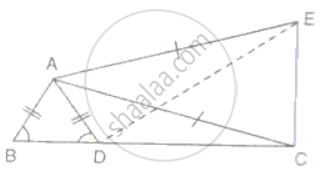
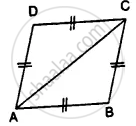
State, whether the pairs of triangles given in the following figures are congruent or not:


Advertisements
उत्तर
In these triangles, corresponding two sides are equal but included angles are not-equal. Hence these are not congruent triangles.
APPEARS IN
संबंधित प्रश्न
Mark the correct alternative in each of the following:
If ABC ≅ ΔLKM, then side of ΔLKM equal to side AC of ΔABC is
In ΔPQR ≅ ΔEFD then ED =
If ΔPQR≅ ΔEFD, then ∠E =
ABC is an isosceles triangle such that AB = AC and AD is the median to base BC. Then, ∠BAD =
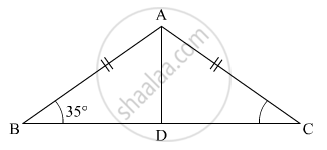
In the given figure, ABC is a triangle in which ∠B = 2∠C. D is a point on side BC such that ADbisects ∠BAC and AB = CD. BE is the bisector of ∠B. The measure of ∠BAC is
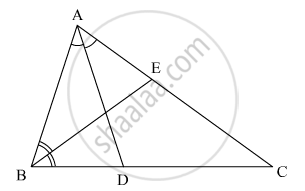
In the given figure, ∠P ≅ ∠R seg, PQ ≅ seg RQ. Prove that, ΔPQT ≅ ΔRQS.
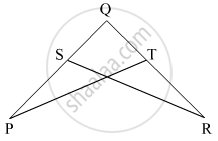
The following figure shown a triangle ABC in which AB = AC. M is a point on AB and N is a point on AC such that BM = CN.
Prove that:
Prove that:
(i) ∆ ABC ≅ ∆ ADC
(ii) ∠B = ∠D
In the figure, AB = EF, BC = DE, AB and FE are perpendiculars on BE. Prove that ΔABD ≅ ΔFEC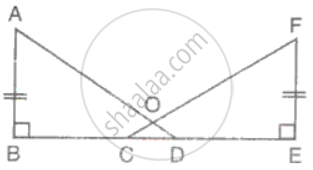
In the figure, AC = AE, AB = AD and ∠BAD = ∠EAC. Prove that BC = DE.