Advertisements
Advertisements
प्रश्न
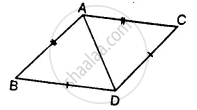
State, whether the pairs of triangles given in the following figures are congruent or not:
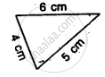
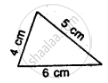
Advertisements
उत्तर
In these triangles, the corresponding three sides are equal.
Hence these are congruent triangles.
(S.S.S. Axiom)
APPEARS IN
संबंधित प्रश्न
If ΔDEF ≅ ΔBCA, write the part(s) of ΔBCA that correspond to ∠E
In triangles ABC and PQR three equality relations between some parts are as follows:
AB = QP, ∠B = ∠P and BC = PR
State which of the congruence conditions applies:
Which of the following is not a criterion for congruence of triangles?
The following figure shown a triangle ABC in which AB = AC. M is a point on AB and N is a point on AC such that BM = CN.
Prove that:
State, whether the pairs of triangles given in the following figures are congruent or not:
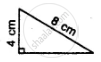
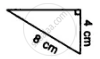
In the given figure, prove that: ∆ ABD ≅ ∆ ACD
Which of the following pairs of triangles are congruent? Give reasons
ΔABC;(∠B = 70°,BC = 6cm,∠C = 50°);
ΔXYZ;(∠Z = 60°,XY = 6cm,∠X = 70°).
Which of the following rule is not sufficient to verify the congruency of two triangles
The top and bottom faces of a kaleidoscope are congruent.
Without drawing the triangles write all six pairs of equal measures in the following pairs of congruent triangles.
∆YZX ≅ ∆PQR
