Advertisements
Advertisements
प्रश्न
ABCD is a quadrilateral in which AB = BC and AD = CD. Show that BD bisects both the angles ABC and ADC.
Advertisements
उत्तर
Given: ABCD is a quadrilateral in which AB = BC and AD = CD.
To show: BD bisects both the angles ABC and ADC.
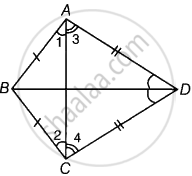
Proof: Since, AB = BC ...(Given)
∴ ∠2 = ∠1 ...(i) [Angles opposite to equal sides are equal]
And AD = CD ...[Given]
⇒ ∠4 = ∠3 ...(ii) [Angles opposite to equal sides are equal]
On adding equations (i) and (ii), we get
∠2 + ∠4 = ∠1 + ∠3
⇒ ∠BCD = ∠BAD ...(iii)
In ΔBAD and ΔBCD,
AB = BC ...[Given]
∠BAD = ∠BCD ...[From equation (iii)]
And AD = CD ...[Given]
∴ ΔBAD ≅ ΔBCD ...[By SAS congruence rule]
Hence, ∠ABD = ∠CBD and ∠ADB = ∠CDB i.e., BD bisects the angles ABC and ADC. ...[By CPCT]
APPEARS IN
संबंधित प्रश्न
If ΔDEF ≅ ΔBCA, write the part(s) of ΔBCA that correspond to ∠F
BD and CE are bisectors of ∠B and ∠C of an isosceles ΔABC with AB = AC. Prove that BD = CE.
If ΔABC ≅ ΔABC is isosceles with
In the following example, a pair of triangles is shown. Equal parts of triangle in each pair are marked with the same sign. Observe the figure and state the test by which the triangle in each pair are congruent.
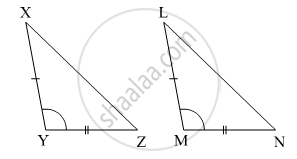
By ______ test
ΔXYZ ≅ ΔLMN
In the following diagram, AP and BQ are equal and parallel to each other.
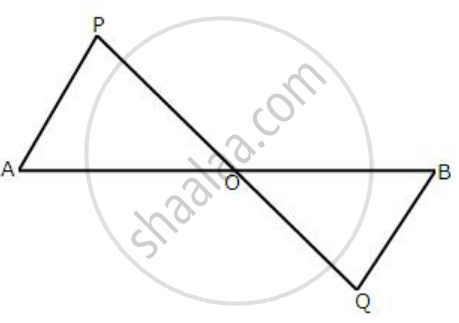
Prove that:
- ΔAOP ≅ ΔBOQ.
- AB and PQ bisect each other.
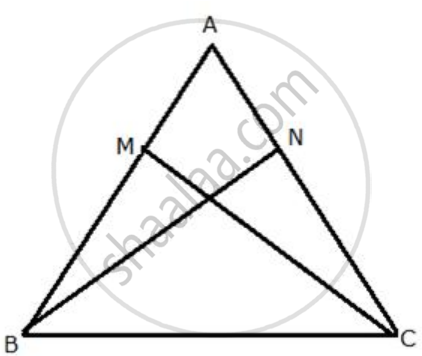
The following figure has shown a triangle ABC in which AB = AC. M is a point on AB and N is a point on AC such that BM = CN.
Prove that: (i) AM = AN (ii) ΔAMC ≅ ΔANB
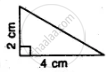
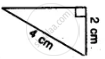
State, whether the pairs of triangles given in the following figures are congruent or not:
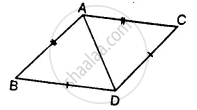
In the given figure, prove that: ∆ ABD ≅ ∆ ACD
In ΔABC, AB = AC and the bisectors of angles B and C intersect at point O.Prove that BO = CO and the ray AO is the bisector of angle BAC.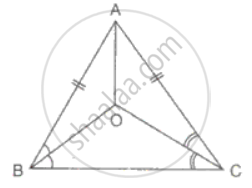
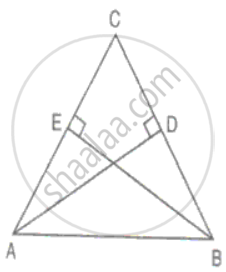
AD and BE are altitudes of an isosceles triangle ABC with AC = BC. Prove that AE = BD.