Advertisements
Advertisements
प्रश्न
ABCD is a quadrilateral in which AB = BC and AD = CD. Show that BD bisects both the angles ABC and ADC.
Advertisements
उत्तर
Given: ABCD is a quadrilateral in which AB = BC and AD = CD.
To show: BD bisects both the angles ABC and ADC.
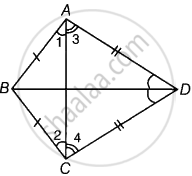
Proof: Since, AB = BC ...(Given)
∴ ∠2 = ∠1 ...(i) [Angles opposite to equal sides are equal]
And AD = CD ...[Given]
⇒ ∠4 = ∠3 ...(ii) [Angles opposite to equal sides are equal]
On adding equations (i) and (ii), we get
∠2 + ∠4 = ∠1 + ∠3
⇒ ∠BCD = ∠BAD ...(iii)
In ΔBAD and ΔBCD,
AB = BC ...[Given]
∠BAD = ∠BCD ...[From equation (iii)]
And AD = CD ...[Given]
∴ ΔBAD ≅ ΔBCD ...[By SAS congruence rule]
Hence, ∠ABD = ∠CBD and ∠ADB = ∠CDB i.e., BD bisects the angles ABC and ADC. ...[By CPCT]
APPEARS IN
संबंधित प्रश्न
Find the measure of each angle of an equilateral triangle.
In triangles ABC and PQR, if ∠A = ∠R, ∠B = ∠P and AB = RP, then which one of the following congruence conditions applies:
If ABC and DEF are two triangles such that ΔABC \[\cong\] ΔFDE and AB = 5cm, ∠B = 40°
In the pair of triangles in the following figure, parts bearing identical marks are congruent. State the test and the correspondence of vertices by the triangle in pairs is congruent.
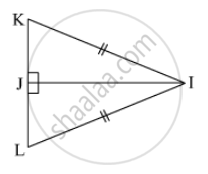
State, whether the pairs of triangles given in the following figures are congruent or not:


Prove that:
(i) ∆ ABC ≅ ∆ ADC
(ii) ∠B = ∠D
(iii) AC bisects angle DCB
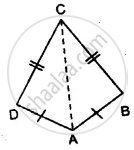
Which of the following pairs of triangles are congruent? Give reasons
ΔABC;(BC = 5cm,AC = 6cm,∠C = 80°);
ΔXYZ;(XZ = 6cm,XY = 5cm,∠X = 70°).
Which of the following pairs of triangles are congruent? Give reasons
ΔABC;(∠B = 70°,BC = 6cm,∠C = 50°);
ΔXYZ;(∠Z = 60°,XY = 6cm,∠X = 70°).
Sides, AB, BC and the median AD of ΔABC are equal to the two sides PQ, QR and the median PM of ΔPQR. Prove that ΔABC ≅ ΔPQR.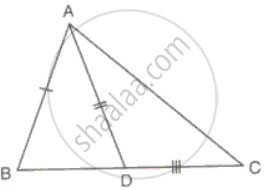
Which of the following rule is not sufficient to verify the congruency of two triangles
