Advertisements
Advertisements
प्रश्न
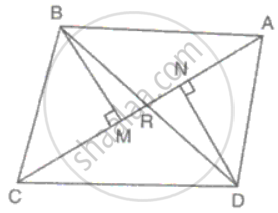
In the figure, BM and DN are both perpendiculars on AC and BM = DN. Prove that AC bisects BD.
Advertisements
उत्तर
In ΔBMR and DNR
BM = DN
∠BMR = ∠DNR = 90°
∠BRM = ∠DRN = ...(vertically opposite angles)
Hence, ∠MBR = ∠NDR ...(sum of angles of a triangle = 180°)
ΔBMR ≅ ΔDNR ...(ASR criteria)
Therefore, BR = DR
So, AC bisects BD.
APPEARS IN
संबंधित प्रश्न
If ΔDEF ≅ ΔBCA, write the part(s) of ΔBCA that correspond to ∠F
CDE is an equilateral triangle formed on a side CD of a square ABCD. Show that ΔADE ≅ΔBCE.
The following figure shown a triangle ABC in which AB = AC. M is a point on AB and N is a point on AC such that BM = CN.
Prove that: ΔAMC≅ ΔANB

State, whether the pairs of triangles given in the following figures are congruent or not:

State, whether the pairs of triangles given in the following figures are congruent or not:

Which of the following pairs of triangles are congruent? Give reasons
ΔABC;(∠B = 90°,BC = 6cm,AB = 8cm);
ΔPQR;(∠Q = 90°,PQ = 6cm,PR = 10cm).
ΔABC is isosceles with AB = AC. BD and CE are two medians of the triangle. Prove that BD = CE.
ΔABC is an isosceles triangle with AB = AC. GB and HC ARE perpendiculars drawn on BC.
Prove that
(i) BG = CH
(ii) AG = AH
Is it possible to construct a triangle with lengths of its sides as 4 cm, 3 cm and 7 cm? Give reason for your answer.
Without drawing the triangles write all six pairs of equal measures in the following pairs of congruent triangles.
∆ABC ≅ ∆LMN
