Advertisements
Advertisements
Question
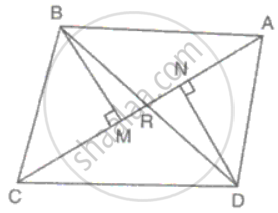
In the figure, BM and DN are both perpendiculars on AC and BM = DN. Prove that AC bisects BD.
Advertisements
Solution
In ΔBMR and DNR
BM = DN
∠BMR = ∠DNR = 90°
∠BRM = ∠DRN = ...(vertically opposite angles)
Hence, ∠MBR = ∠NDR ...(sum of angles of a triangle = 180°)
ΔBMR ≅ ΔDNR ...(ASR criteria)
Therefore, BR = DR
So, AC bisects BD.
APPEARS IN
RELATED QUESTIONS
If ΔDEF ≅ ΔBCA, write the part(s) of ΔBCA that correspond to `bar(DF)`
Mark the correct alternative in each of the following:
If ABC ≅ ΔLKM, then side of ΔLKM equal to side AC of ΔABC is
In a triangle, ABC, AB = BC, AD is perpendicular to side BC and CE is perpendicular to side AB. Prove that: AD = CE.
State, whether the pairs of triangles given in the following figures are congruent or not:

In the given figure, prove that: ∆ ABD ≅ ∆ ACD

Prove that in an isosceles triangle the altitude from the vertex will bisect the base.
In ΔABC, AB = AC, BM and Cn are perpendiculars on AC and AB respectively. Prove that BM = CN.
“If two angles and a side of one triangle are equal to two angles and a side of another triangle, then the two triangles must be congruent.” Is the statement true? Why?
Two figures are congruent, if they have the same shape.
Without drawing the triangles write all six pairs of equal measures in the following pairs of congruent triangles.
∆XYZ ≅ ∆MLN
