Advertisements
Advertisements
Question
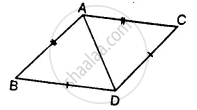
In the given figure, prove that: ∆ ABD ≅ ∆ ACD
Advertisements
Solution
Proof:
In Δ ABD and Δ ACD,
AD = AD ..............(common)
AB = AC ...............(given)
BD = DC ...............(given)
∴ Δ ABD ≅ Δ ACD .............(S.S.S. Axiom)
Hence proved.
APPEARS IN
RELATED QUESTIONS
In a ΔPQR, if PQ = QR and L, M and N are the mid-points of the sides PQ, QR and RP
respectively. Prove that: LN = MN.
In ΔTPQ, ∠T = 65°, ∠P = 95° which of the following is a true statement?
In the pair of triangles in the following figure, parts bearing identical marks are congruent. State the test and the correspondence of vertices by the triangle in pairs is congruent.
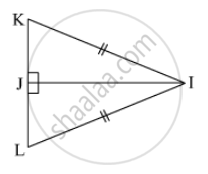
In the adjacent figure, seg AD ≌ seg EC Which additional information is needed to show that ∆ ABD and ∆ EBC will be congruent by A-A-S test?
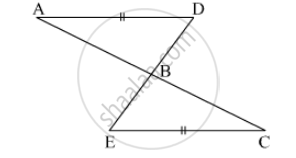
State, whether the pairs of triangles given in the following figures are congruent or not:
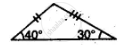
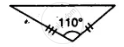
Which of the following pairs of triangles are congruent? Give reasons
ΔABC;(BC = 5cm,AC = 6cm,∠C = 80°);
ΔXYZ;(XZ = 6cm,XY = 5cm,∠X = 70°).
Which of the following pairs of triangles are congruent? Give reasons
ΔABC;(AB = 5cm,BC = 7cm,CA = 9cm);
ΔKLM;(KL = 7cm,LM = 5cm,KM = 9cm).
In the given figure P is a midpoint of chord AB of the circle O. prove that OP ^ AB.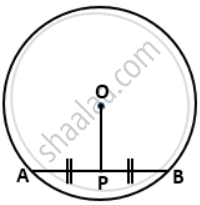
If the perpendicular bisector of the sides of a triangle PQR meet at I, then prove that the line joining from P, Q, R to I are equal.
In ΔABC, AD is a median. The perpendiculars from B and C meet the line AD produced at X and Y. Prove that BX = CY.
