Advertisements
Advertisements
प्रश्न
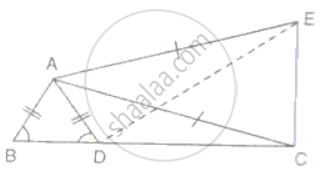
In the figure, AC = AE, AB = AD and ∠BAD = ∠EAC. Prove that BC = DE.
Advertisements
उत्तर
In ΔADE and ΔBAC
AE = AC
AB = AD
∠BAD = ∠EAC
∠DAC = ∠DAC = DAC ...(common)
⇒ ∠BAC = ∠EAD = EAD
Therefore, ΔADE ≅ ΔBAC ...(SAS criteria)
Hence, BC = DE.
APPEARS IN
संबंधित प्रश्न
In the given figure, if AB = AC and ∠B = ∠C. Prove that BQ = CP.

In ΔPQR ≅ ΔEFD then ED =
In the adjacent figure, seg AD ≌ seg EC Which additional information is needed to show that ∆ ABD and ∆ EBC will be congruent by A-A-S test?

On the sides AB and AC of triangle ABC, equilateral triangle ABD and ACE are drawn. Prove that:
- ∠CAD = ∠BAE
- CD = BE
In the following figure, OA = OC and AB = BC.
Prove that:
(i) ∠AOB = 90o
(ii) ΔAOD ≅ ΔCOD
(iii) AD = CD
State, whether the pairs of triangles given in the following figures are congruent or not:
Δ ABC in which AB = 2 cm, BC = 3.5 cm and ∠C = 80° and Δ DEF in which DE = 2 cm, DF = 3.5 cm and ∠D = 80°.
ΔABC is isosceles with AB = AC. BD and CE are two medians of the triangle. Prove that BD = CE.
O is any point in the ΔABC such that the perpendicular drawn from O on AB and AC are equal. Prove that OA is the bisector of ∠BAC.
Is it possible to construct a triangle with lengths of its sides as 4 cm, 3 cm and 7 cm? Give reason for your answer.
It is given that ∆ABC ≅ ∆RPQ. Is it true to say that BC = QR? Why?
