Advertisements
Advertisements
Question
“If two sides and an angle of one triangle are equal to two sides and an angle of another triangle, then the two triangles must be congruent.” Is the statement true? Why?
Options
True
False
Advertisements
Solution
This statement is False.
Explanation:
Because in the congruent rule, the two sides and the included angle of one triangle are equal to the two sides and the included angle of the other triangle i.e., SAS rule.
APPEARS IN
RELATED QUESTIONS
If ΔABC ≅ ΔFED under the correspondence ABC ↔ FED, write all the Corresponding congruent parts of the triangles.
If ΔDEF ≅ ΔBCA, write the part(s) of ΔBCA that correspond to ∠F
In a ΔPQR, if PQ = QR and L, M and N are the mid-points of the sides PQ, QR and RP
respectively. Prove that: LN = MN.
In two right triangles one side an acute angle of one are equal to the corresponding side and angle of the othe Prove that the triangles are congruent.
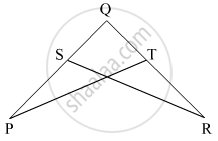
In the given figure, ∠P ≅ ∠R seg, PQ ≅ seg RQ. Prove that, ΔPQT ≅ ΔRQS.
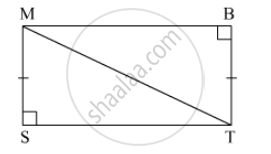
In the pair of triangles given below, the parts shown by identical marks are congruent. State the test and the one-to-one correspondence of vertices by which the triangles in the pair are congruent, the remaining congruent parts.
In the following diagram, ABCD is a square and APB is an equilateral triangle.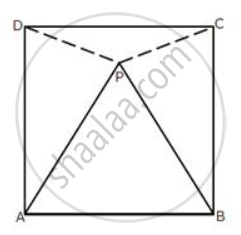
(i) Prove that: ΔAPD≅ ΔBPC
(ii) Find the angles of ΔDPC.
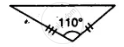
State, whether the pairs of triangles given in the following figures are congruent or not:
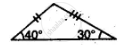
In ΔABC, AB = AC and the bisectors of angles B and C intersect at point O.Prove that BO = CO and the ray AO is the bisector of angle BAC.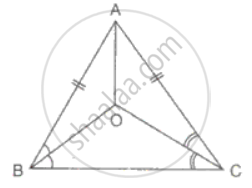
In the given figure ABCD is a parallelogram, AB is Produced to L and E is a midpoint of BC. Show that: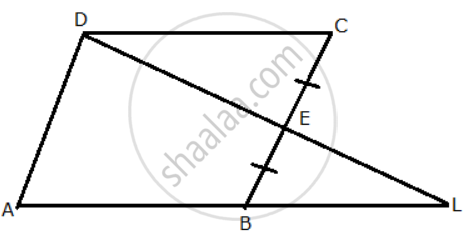
a. DDCE ≅ DLDE
b. AB = BL
c. DC = `"AL"/(2)`
