Advertisements
Advertisements
Question
In ΔPQR, If ∠R > ∠Q then ______.
Options
QR > PR
PQ > PR
PQ < PR
QR < PR
Advertisements
Solution
In ΔPQR, If ∠R > ∠Q then PQ > PR.
APPEARS IN
RELATED QUESTIONS
If one angle of a triangle is equal to the sum of the other two, show that the triangle is a
right triangle.
The exterior angles, obtained on producing the base of a triangle both way are 104° and 136°. Find all the angles of the triangle.
Is the following statement true and false :
Sum of the three angles of a triangle is 180 .
Is the following statement true and false :
A triangle can have two right angles.
Is the following statement true and false :
All the angles of a triangle can be equal to 60°.
Is the following statement true and false :
A triangle can have two obtuse angles.
Is the following statement true and false :
If one angle of a triangle is obtuse, then it cannot be a right angled triangle.
Is the following statement true and false :
An exterior angle of a triangle is equal to the sum of the two interior opposite angles.
Fill in the blank to make the following statement true:
An exterior angle of a triangle is equal to the two ....... opposite angles.
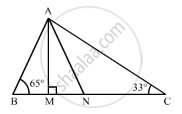
In the given figure, AM ⊥ BC and AN is the bisector of ∠A. If ∠B = 65° and ∠C = 33°, find ∠MAN.
In Δ ABC, BD⊥ AC and CE ⊥ AB. If BD and CE intersect at O, prove that ∠BOC = 180° − A.
In ΔABC, if bisectors of ∠ABC and ∠ACB intersect at O at angle of 120°, then find the measure of ∠A.
If one angle of a triangle is equal to the sum of the other two angles, then the triangle is
State, if the triangle is possible with the following angles :
40°, 130°, and 20°
Calculate the angles of a triangle if they are in the ratio 4: 5: 6.
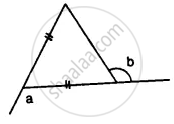
In the given figure, express a in terms of b.
Find x, if the angles of a triangle is:
x°, 2x°, 2x°
Find x, if the angles of a triangle is:
2x°, 4x°, 6x°
Which two triangles have ∠B in common?
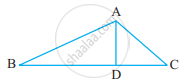
How many angles are there inside a triangle?
