Advertisements
Advertisements
Question
In Δ ABC, BD⊥ AC and CE ⊥ AB. If BD and CE intersect at O, prove that ∠BOC = 180° − A.
Advertisements
Solution
In the given ΔABC, BD⊥AC and CE⊥AB.
We need prove ∠BOC = 180° - ∠A
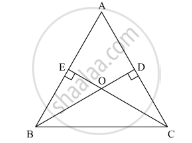
Here, in ΔBDC, using the exterior angle theorem, we get,
∠BDA = ∠DBC + ∠DBC
90 = ∠DBO + ∠DBC ................ (1)
Similarly, in ΔEBC, we get,
∠AEC = ∠EBC + ∠ECB
90 = ∠EBC ∠ECB ................ (2)
Adding (1) and (2), we get,
90 + 90 = ∠DBC + ∠DCB + ∠EBC + ∠ECB
180 = (∠DCB +∠EBC) + (∠DBC+∠ECB)................ (3)
Now, on using angle sum property,
In ΔABC, we get,
∠BAC + ∠ABC + ∠ACB = 180
∠ABC + ∠ACB = 180 - ∠BAC
This can be written as,
∠EBC + ∠DCB = 180 - ∠A ......... (4)
Similarly, using angle sum property in ΔOBC, we get,
∠BOC + ∠OBC + ∠OCB = 180
∠OBC + ∠OCB = 180 - ∠BOC
This can be written as,
∠DBC + ∠ECB = 180 - ∠BOC ......... (5)
Now, using the values of (4) and (5) in (3), we get,
180 = 180 - ∠BOC ........... (5)
180 = 360 - ∠A - ∠BOC
∠BOC = 360 - 180 - ∠A
∠BOC = 180 - ∠A
Therefore, ∠BOC = 180 - ∠A.
Hence proved
APPEARS IN
RELATED QUESTIONS
The angles of a triangle are (x − 40)°, (x − 20)° and `(1/2x-10)^@.` find the value of x
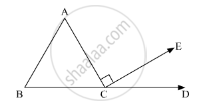
In the given figure, AC ⊥ CE and ∠A : ∠B : ∠C = 3 : 2 : 1, find the value of ∠ECD.
Fill in the blank to make the following statement true:
Sum of the angles of a triangle is ....
If two acute angles of a right triangle are equal, then each acute is equal to
Side BC of a triangle ABC has been produced to a point D such that ∠ACD = 120°. If ∠B = \[\frac{1}{2}\]∠A is equal to
In a triangle, an exterior angle at a vertex is 95° and its one of the interior opposite angle is 55°, then the measure of the other interior angle is
The bisects of exterior angle at B and C of ΔABC meet at O. If ∠A = x°, then ∠BOC =
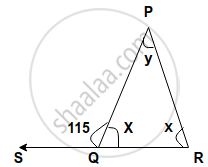
Find, giving a reason, the unknown marked angles, in a triangle drawn below:
The length of the three segments is given for constructing a triangle. Say whether a triangle with these sides can be drawn. Give the reason for your answer.
8.4 cm, 16.4 cm, 4.9 cm
Draw a rough sketch of a triangle ABC. Mark a point P in its interior and a point Q in its exterior. Is point A in its exterior or in its interior?
