Advertisements
Advertisements
Question
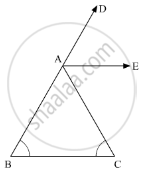
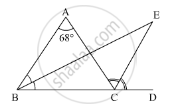
In the given figure, AE bisects ∠CAD and ∠B= ∠C. Prove that AE || BC.
Advertisements
Solution
In the given problem, AE bisects ∠CAD and ∠B = ∠C
We need to prove AE || BC
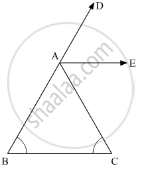
As, ∠CAD is bisected by AE
∠CAD = 2∠CAE - 2∠DAE ..........(1)
Now, using the property, “an exterior angle of a triangle in equal to the sum of the two opposite interior angles”, we get,
∠CAD ∠B +∠C
∠CAD = 2∠C (∠B = ∠C)
2∠CAE = 2∠C (using 1)
∠CAE = ∠C
∠CAE = ∠ACB
Hence, using the property, if alternate interior angles are equal, then the two lines are parallel, we get,
∠CAE = ∠ACB
Thus,AE || BC
Hence proved.
APPEARS IN
RELATED QUESTIONS
Two angles of a triangle are equal and the third angle is greater than each of those angles
by 30°. Determine all the angles of the triangle.
In the given figure, AC ⊥ CE and ∠A : ∠B : ∠C = 3 : 2 : 1, find the value of ∠ECD.
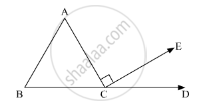
In the given figure, side BC of ΔABC is produced to point D such that bisectors of ∠ABC and ∠ACD meet at a point E. If ∠BAC = 68°, find ∠BEC.
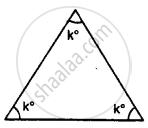
Find the unknown marked angles in the given figure:
One angle of a triangle is 61° and the other two angles are in the ratio `1 1/2: 1 1/3`. Find these angles.
One angle of a right-angled triangle is 70°. Find the other acute angle.
The length of the three segments is given for constructing a triangle. Say whether a triangle with these sides can be drawn. Give the reason for your answer.
15 cm, 20 cm, 25 cm
The number of angles in the following figure is ______.

Draw a rough sketch of a triangle ABC. Mark a point P in its interior and a point Q in its exterior. Is point A in its exterior or in its interior?
Identify three triangles in the figure.