Advertisements
Advertisements
प्रश्न
In ΔPQR, If ∠R > ∠Q then ______.
विकल्प
QR > PR
PQ > PR
PQ < PR
QR < PR
Advertisements
उत्तर
In ΔPQR, If ∠R > ∠Q then PQ > PR.
APPEARS IN
संबंधित प्रश्न
The angles of a triangle are (x − 40)°, (x − 20)° and `(1/2x-10)^@.` find the value of x
If one angle of a triangle is equal to the sum of the other two, show that the triangle is a
right triangle.
If the bisectors of the base angles of a triangle enclose an angle of 135°, prove that the triangle is a right triangle.
If the side BC of ΔABC is produced on both sides, then write the difference between the sum of the exterior angles so formed and ∠A.
An exterior angle of a triangle is equal to 100° and two interior opposite angles are equal. Each of these angles is equal to
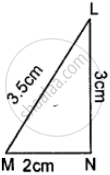
Classify the following triangle according to sides:
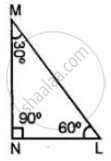
Classify the following triangle according to angle:
The angles of the triangle are 3x – 40, x + 20 and 2x – 10 then the value of x is
Can 30°, 60° and 90° be the angles of a triangle?
In the given figure, AB is parallel to CD. Then the value of b is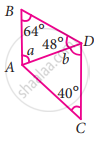
Match the following:
| Column A | Column B |
| (i) No sides are equal | Isosceles triangle |
| (ii) One right angle | Scalene triangle |
| (iii) One obtuse angle | Right angled triangle |
| (iv) Two sides of equal length | Equilateral triangle |
| (v) All sides are equal | Obtuse angled triangle |
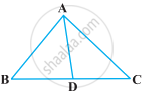
In the following figure, AD is the bisector of ∠BAC. Prove that AB > BD.
Prove that in a triangle, other than an equilateral triangle, angle opposite the longest side is greater than `2/3` of a right angle.
What is common in the following figure?
 |
 |
| (i) | (ii) |
Is figure (i) that of triangle? if not, why?
Can we have two acute angles whose sum is an obtuse angle? Why or why not?
Can we have two acute angles whose sum is a straight angle? Why or why not?
Identify three triangles in the figure.
How many sides does a triangle have?
