Advertisements
Advertisements
Question
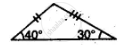
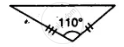
State, whether the pairs of triangles given in the following figures are congruent or not:
Advertisements
Solution
In the first A, third angle
= 180° – (40°+ 30°)
= 180° – 70°
= 110°
Now in these two triangles the sides and included angle of the one are equal to the corresponding sides and included angle.
Hence these are congruent triangles
(S.A.S. axiom)
APPEARS IN
RELATED QUESTIONS
In two right triangles one side an acute angle of one are equal to the corresponding side and angle of the othe Prove that the triangles are congruent.
In triangles ABC and PQR three equality relations between some parts are as follows:
AB = QP, ∠B = ∠P and BC = PR
State which of the congruence conditions applies:
Which of the following is not a criterion for congruence of triangles?
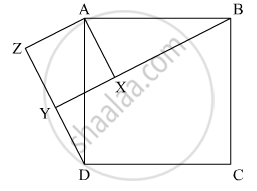
In the given figure, X is a point in the interior of square ABCD. AXYZ is also a square. If DY = 3 cm and AZ = 2 cm, then BY =
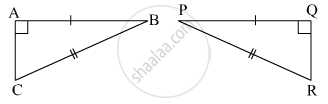
From the information shown in the figure, state the test assuring the congruence of ΔABC and ΔPQR. Write the remaining congruent parts of the triangles.
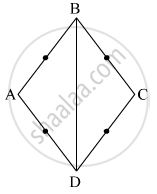
In the given figure, seg AB ≅ seg CB and seg AD ≅ seg CD. Prove that ΔABD ≅ ΔCBD.
In ΔTPQ, ∠T = 65°, ∠P = 95° which of the following is a true statement?
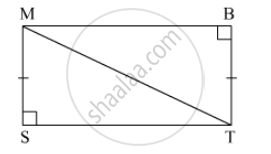
In the pair of triangles given below, the parts shown by identical marks are congruent. State the test and the one-to-one correspondence of vertices by which the triangles in the pair are congruent, the remaining congruent parts.
Given that ∆ABC ≅ ∆DEF List all the corresponding congruent angles
If AB = QR, BC = PR and CA = PQ, then ______.
