Advertisements
Advertisements
Question
In the given figure, show that: ∠a = ∠b + ∠c
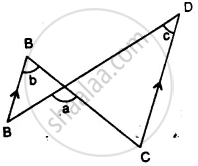
(i) If ∠b = 60° and ∠c = 50° ; find ∠a.
(ii) If ∠a = 100° and ∠b = 55° : find ∠c.
(iii) If ∠a = 108° and ∠c = 48° ; find ∠b.
Advertisements
Solution
∵ AB || CD
∴ b = c and ∠A = ∠C ........(Alternate angles)
Now in Δ PCD,
Ext. ∠APC = ∠C + ∠D
⇒ a = b + c
(i) If b = 60°, c = 50°, then
a = b + c = 60° + 50° = 110°
(ii) If a = 100° and b = 55°,
then a = b + c
⇒ 100° = 55°+ c
⇒ c = 100°− 55° = 45°
(iii) If a = 108° and c = 48°
then a = b + c
⇒ 108° = b + 48°
⇒ b = 108°− 48° = 60°
APPEARS IN
RELATED QUESTIONS
If the bisectors of the base angles of a triangle enclose an angle of 135°, prove that the triangle is a right triangle.
Is the following statement true and false :
A triangle can have at most one obtuse angles.
Is the following statement true and false :
An exterior angle of a triangle is equal to the sum of the two interior opposite angles.
In a triangle, an exterior angle at a vertex is 95° and its one of the interior opposite angle is 55°, then the measure of the other interior angle is
In the following, find the marked unknown angle:
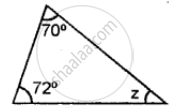
In ∆ABC, C = 56° C = 56° ∠B = ∠C and ∠A = 100° ; find ∠B.
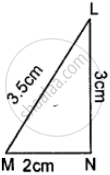
Classify the following triangle according to sides:
The correct statement out of the following is 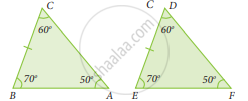
In the following figure, AB = BC and AD = BD = DC. The number of isosceles triangles in the figure is ______.

Can we have two acute angles whose sum is an obtuse angle? Why or why not?
